
A worm-test result can look straightforward until the individual animals behind the average come into view. New Beef + Lamb New Zealand guidance, published on 27 October, draws attention to a practical choice for farmers: whether they need a quick picture of the mob, or a closer look at the variation within it. [1]
The distinction matters before comparing testing equipment or prices. A lower-cost test that answers the question can be good value. A test that leaves the important question unresolved may simply lead to another round of sampling. The useful starting point is the decision the farmer and animal-health adviser need to make.
An average is only one part of the result
A faecal egg count, or FEC, measures eggs in dung and provides a guide to egg-laying adult worms. B+LNZ’s Wormwise resource distinguishes individual testing, which preserves the range of results, from composite testing, which combines samples and reports an average. The latter is faster and cheaper, but provides less detail. [2]
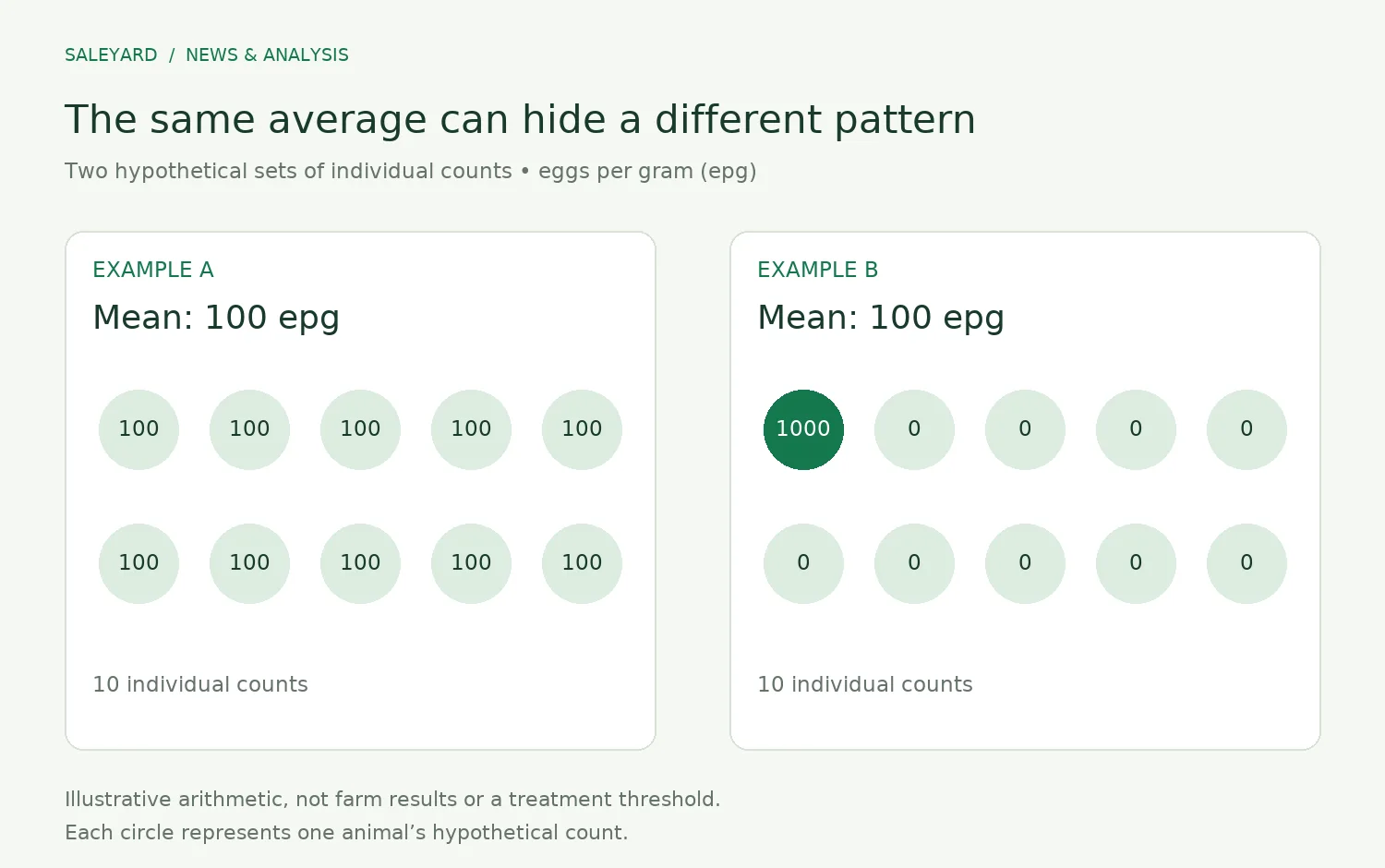
Consider two hypothetical sets of ten individual counts. In one, every animal records 100 eggs per gram. In the other, nine record zero and one records 1,000. Both sets have an arithmetic mean of 100, despite the very different patterns. These are invented examples to explain averages, not farm observations or treatment thresholds.
View chart data
| Animal | Example A (epg) | Example B (epg) |
|---|---|---|
| 1 | 100 | 1000 |
| 2 | 100 | 0 |
| 3 | 100 | 0 |
| 4 | 100 | 0 |
| 5 | 100 | 0 |
| 6 | 100 | 0 |
| 7 | 100 | 0 |
| 8 | 100 | 0 |
| 9 | 100 | 0 |
| 10 | 100 | 0 |
The example does not mean a pooled laboratory sample would return exactly that arithmetic mean. Collection, mixing and measurement introduce variation. It shows the information an average alone cannot provide: whether the result is broadly shared or concentrated in a small part of the sampled group.
Choose the sampling plan before the testing service
Wormwise describes individual testing using at least ten samples, processed separately. For a composite, it describes collecting 15–30 samples, taking a standard volume from each dung pat and mixing thoroughly. These approaches answer different questions; a cheap composite result should not be treated as though every animal was tested individually. [2]
For a farmer comparing services, that makes the sampling plan part of the quote. Ask whether the price covers individual counts or a composite, how samples should be collected, when results will arrive and what interpretation is included. Comparing the cost per reported number without those details can compare quite different services.
The new guidance says repeat monitoring can be more informative than an isolated result, particularly for composites. It also highlights limitations: immature worms are not detected through eggs, egg output varies, and an ordinary count does not identify all worm species. Results therefore need the animal’s history and condition alongside them. [1]
The return comes from a better decision
There is no universal dollar saving in the guidance. On a particular farm, the economic question is whether the extra information is likely to change management enough to justify its cost. That could mean paying for greater detail when it matters, or using a simpler repeatable approach when the question is about a mob’s trend.
The same discipline applies to new automated equipment. Buying a faster result is useful only if collection, interpretation and follow-up fit the farm’s routine. A machine’s convenience does not turn one sample into a complete account of animal performance.
B+LNZ puts the emphasis on participation rather than the gadget: “the important part is that you are monitoring”. Its advice is to interpret results with a trusted animal-health adviser, taking account of previous treatment, age, feed and body condition. [1]
For sheep and young-stock farmers, the practical task is to make the next test answer a clear question. Record the mob, sampling method and relevant history, then agree how the result will be used. The average may be useful. Knowing what it leaves out can be just as valuable.