Wool buyers took a much larger share of the offering at the latest national auction, giving growers a stronger selling signal as spring shearing progresses. Yet the most useful number for a farm budget may be the one missing from the headline: how much clean wool its clip actually yields. [1]
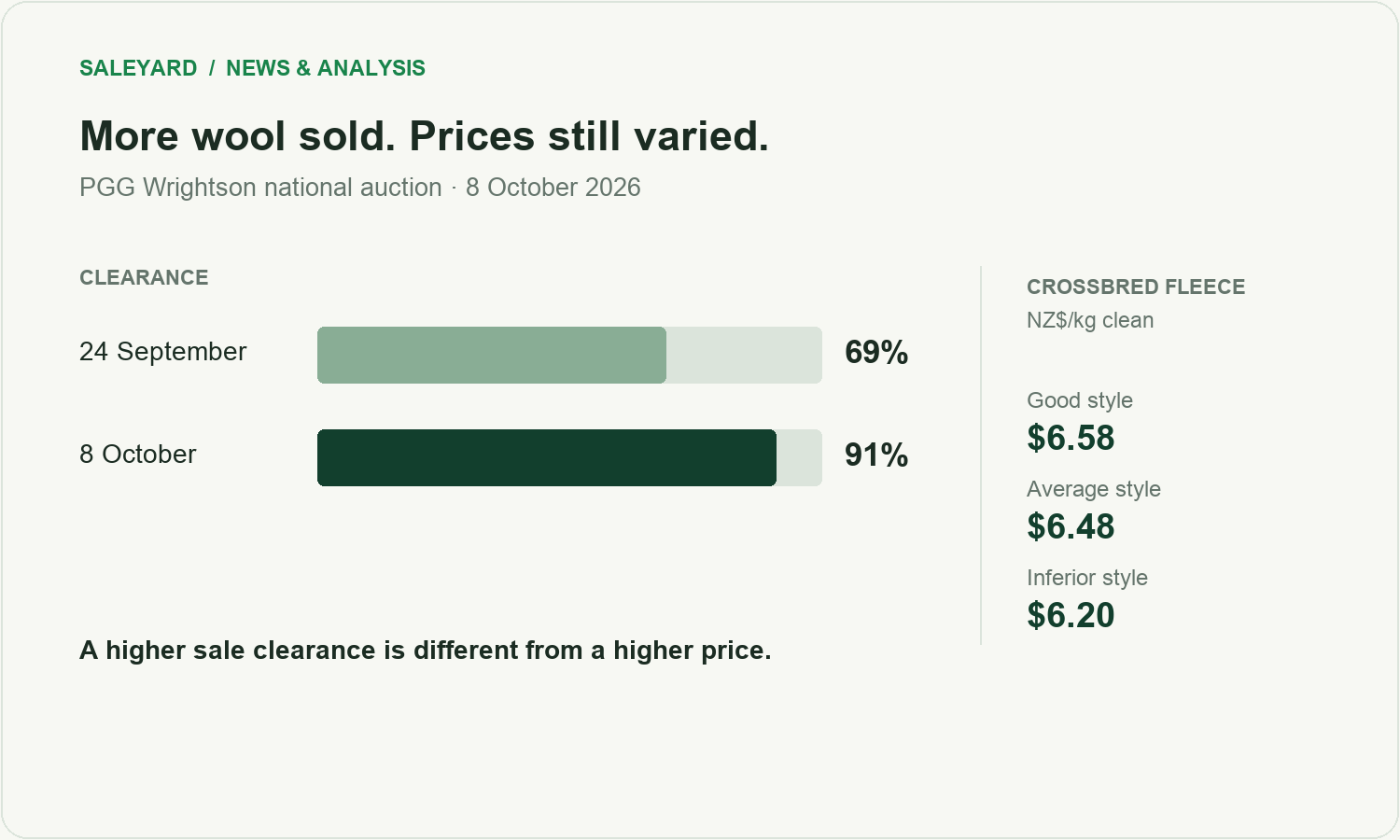
PGG Wrightson reported 91% sold at its 8 October sale, compared with 69% on 24 September. The improvement was 22 percentage points. That is encouraging evidence of wool finding buyers, rather than proof that every grower received a higher price. [1] [2]
View chart data
| Measure | Date | Value | Unit |
|---|---|---|---|
| Clearance | 24 September 2026 | 69 | % sold |
| Clearance | 8 October 2026 | 91 | % sold |
| Crossbred fleece, good style | 8 October 2026 | 6.58 | NZD/kg clean |
| Crossbred fleece, average style | 8 October 2026 | 6.48 | NZD/kg clean |
| Crossbred fleece, inferior style | 8 October 2026 | 6.2 | NZD/kg clean |
National auction manager Dave Burridge reported Australian exporters active across wool types and supporting competition. His commentary also described prices generally favouring buyers. More wool can sell at the same time as buyers remain selective about what they will pay. [1]
A better clearance is only one part of the recovery
September’s report described a larger-than-anticipated offering and cautious commitments from buyers. Against that background, October’s higher clearance is a useful change. It does not establish that the supply-demand balance has permanently shifted, or that unsold wool from an earlier sale achieved the same outcome. [2]
For a business carrying wool in store, a completed sale releases cash. But the decision to accept a bid still turns on the net return, the cost of holding the wool and the alternatives available. Clearance measures the share sold at that auction; it does not measure the profit on a farm’s annual clip.
Nor should a grower read the latest percentage as a probability that their next consignment will sell. Two auctions contain different wool. Their clearance rates are observations of those offerings, not a controlled comparison of identical lines.
Clean prices need a yield before they become a farm return
The published crossbred fleece prices are on a clean-wool basis. A farmer’s bales contain greasy wool. Scouring removes grease, dirt and other impurities, so multiplying the clean price by the greasy weight overstates the value unless yield is taken into account. [3]
The New Zealand Wool Testing Authority measures yield through sampling and laboratory testing. Colour, fibre diameter, length and strength are also part of the information buyers use to understand the wool they are purchasing. A tested line is more specific than a broad market average. [3]
Consider a simplified example using a $6.50/kg clean price. At a 75% yield, 1,000kg of greasy wool represents 750kg clean, giving a gross equivalent of $4,875. At a 65% yield, the same greasy weight represents 650kg clean and $4,225. The $650 difference comes entirely from yield, with the clean price held constant.
These are illustrative calculations, before selling and handling deductions. They are not quoted returns for a particular clip. Yield conventions also need to match the contract: a test result and a buyer’s price must be compared on the same basis. The calculation explains why a strong clean price alone cannot tell a farmer what will arrive in the bank. [3]
Preparation remains a decision growers can influence
The difference between good and inferior crossbred fleece in the latest report was 38 cents/kg clean. That is a comparison between reported categories, not a guaranteed premium from employing another shedhand. Preparation decisions need to be assessed against the actual clip and the expected improvement. [1]
PGG Wrightson’s published preparation guidance, written by Rosstan Mazey in December 2023, stresses removal of dags and yellow fribs, separation of unwanted fibre and protection against foreign material. Its argument is that consistency and contamination control affect the wool’s commercial usefulness. Those principles remain distinct from any prediction about where prices go next. [4]
“quality preparation of the clip is an investment, not a cost” [4]
The sensible comparison is therefore the cost of better preparation against the extra net value it can reasonably deliver. On a small clip, fixed costs can absorb a material part of the gain. On a larger one, a modest improvement per kilogram can matter more. Neither case justifies treating every preparation expense as automatically profitable.
What to watch at the next sale
The next test is whether stronger clearance continues alongside returns for comparable wool. A grower tracking their own season will get more from matching type, style, yield and net proceeds than from following a single headline indicator.
October’s result gives growers a reason to pay attention. Turning that interest into a useful budget means asking the broker for the value of this clip, on its tested basis, after the relevant costs. That is where a market signal becomes a farm-business number.