
Ballance Agri-Nutrients and the West Coast Focus Farm Trust are continuing on-farm nutrient trials, building on work at Harihari in 2025. For farmers dealing with wet ground and short application windows, the business question is whether an extra fertiliser application produces enough useful feed to pay for itself. [1]
In an original company announcement on 6 October, Ballance said the partners had held site visits in September ahead of the first harvest cut. It said farmers and trust members would be able to visit as the programme progressed, with further details to be shared at AgFest West Coast on 16 and 17 October. [1]
That announcement confirms the programme is under way. It does not provide treatment rates, measured pasture responses or an economic result. Those details will be needed before farmers can judge whether the work supports a change in their own spending. [1]
Find the constraint before buying more fertiliser
Nitrogen can stimulate grass growth, but it works within the constraints of the pasture. DairyNZ’s soil-fertility guidance identifies waterlogged ground and cold conditions as limits on response. It also explains that sulphur deficiency can restrict clover, which has a greater sulphur requirement than grass. [3]
If one limitation remains unresolved, buying more of a different input may give a disappointing return. Identifying the constraint matters more than assuming a bigger application will remove it. Sulphur is one possible limitation identified in the wider technical guidance; the company announcement does not establish the treatments used in the current trials.
DairyNZ distinguishes two sulphur forms: sulphate is readily available to plants and moves rapidly through soil; elemental sulphur needs conversion by soil microorganisms before plants can use it. That is background guidance, not a sulphur rate or treatment claimed for the current West Coast trials. [3]
For a farmer comparing products, nutrient form and timing therefore belong beside the price per tonne. A slower-release form and a readily available form do different jobs. Which is appropriate depends on the soil, the deficit and when the pasture needs the nutrient.
The same spending can buy very different amounts of grass
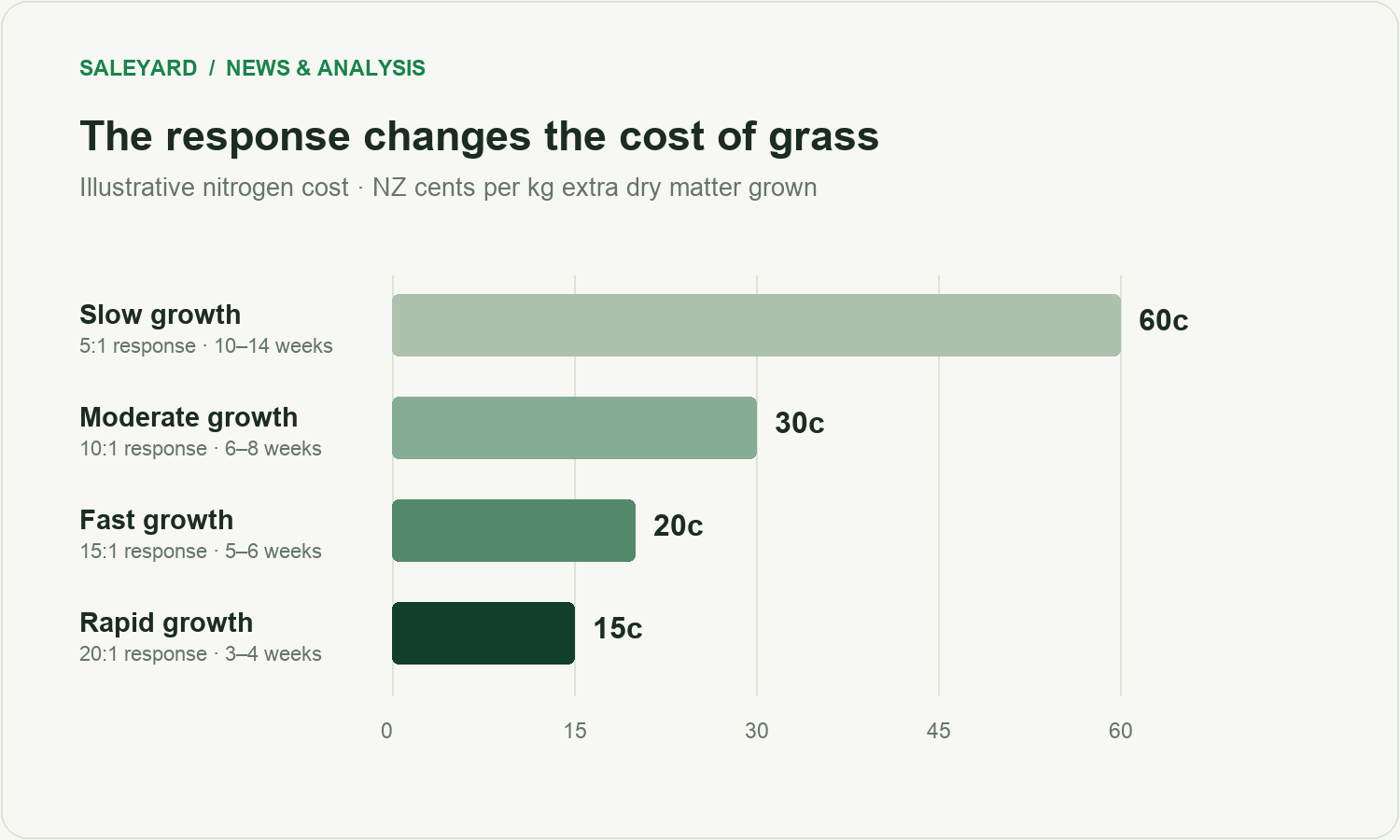
DairyNZ’s nitrogen guidance describes responses ranging from 5kg extra dry matter per kilogram of nitrogen under slow growth to 20kg under rapid growth. Its table also puts the full response at 10–14 weeks in slow-growing pasture, compared with 3–4 weeks in rapid growth. These are general benchmarks, not results from the new West Coast programme. [2]
View chart data
| Growth | Response (kg extra DM/kg N) | Full response (weeks) | Assumed NZD/kg N applied | Cost (NZ cents/kg extra DM grown) |
|---|---|---|---|---|
| Slow | 5 | 10–14 | 3 | 60 |
| Moderate | 10 | 6–8 | 3 | 30 |
| Fast | 15 | 5–6 | 3 | 20 |
| Rapid | 20 | 3–4 | 3 | 15 |
Using an illustrative all-in cost of $3 per kilogram of nitrogen applied, a 5:1 response gives a fertiliser cost of 60 cents per kilogram of extra dry matter grown. A 20:1 response brings that figure to 15 cents. The nitrogen bill is unchanged; the amount of feed grown is four times greater.
Those figures are a sensitivity calculation, not a current fertiliser quote or a forecast for a particular paddock. They include only the assumed nitrogen-and-application cost. Adding sulphur, conservation, feeding or other costs would change the comparison. The point is how strongly the outcome depends on response.
Feed grown is also different from feed eaten. If only three-quarters of that extra pasture is used, the same examples become 80 cents and 20 cents per kilogram utilised, before any further costs. Unused feed still carries the fertiliser bill.
DairyNZ makes utilisation central to nitrogen profitability and advises avoiding application ahead of significant rainfall or drainage events. The response needs to arrive when the farm can use it. Grass arriving after the shortage has passed can have a different value from feed available during it. [2]
Local measurements need to show more than extra growth
Local measurements are valuable when they show how a treatment performed in conditions that farmers recognise. For readers assessing the eventual findings, the important comparison will be extra feed attributable to the treatment against its extra cost. A pasture cut can establish a growth difference; translating that into profit takes a second calculation.
Useful reporting would identify the untreated baseline, the nutrient treatments and the conditions in which each was tested. Readers would also need enough detail to judge whether their own soils and timing resemble the trial. These are questions for the eventual results, rather than claims about the programme’s design.
Ballance is both a trial partner and a fertiliser supplier. Its announcement confirms its involvement, rather than independently establishing a return from a product. Published results will need to carry the case for any change in spending. [1]
A farm budget needs an economic response
Beef + Lamb New Zealand’s fertiliser guidance distinguishes maximum pasture production from the economic optimum: the nutrient level producing the best return on investment can be lower. It recommends prioritising management blocks and using soil-monitoring trends to identify where spending is most useful. [4]
That distinction matters on a wet farm with a limited application window. The best opportunity may be a suitable block that can grow and use feed, rather than a uniform treatment across every hectare. Soil and pasture tests help separate a nutrient shortage from other limits on growth. [3] [4]
The trials could make that choice better informed. For now, their value lies in asking a specific local question. Farmers will need measured response, timing and total cost before deciding whether the answer warrants a different fertiliser bill.