
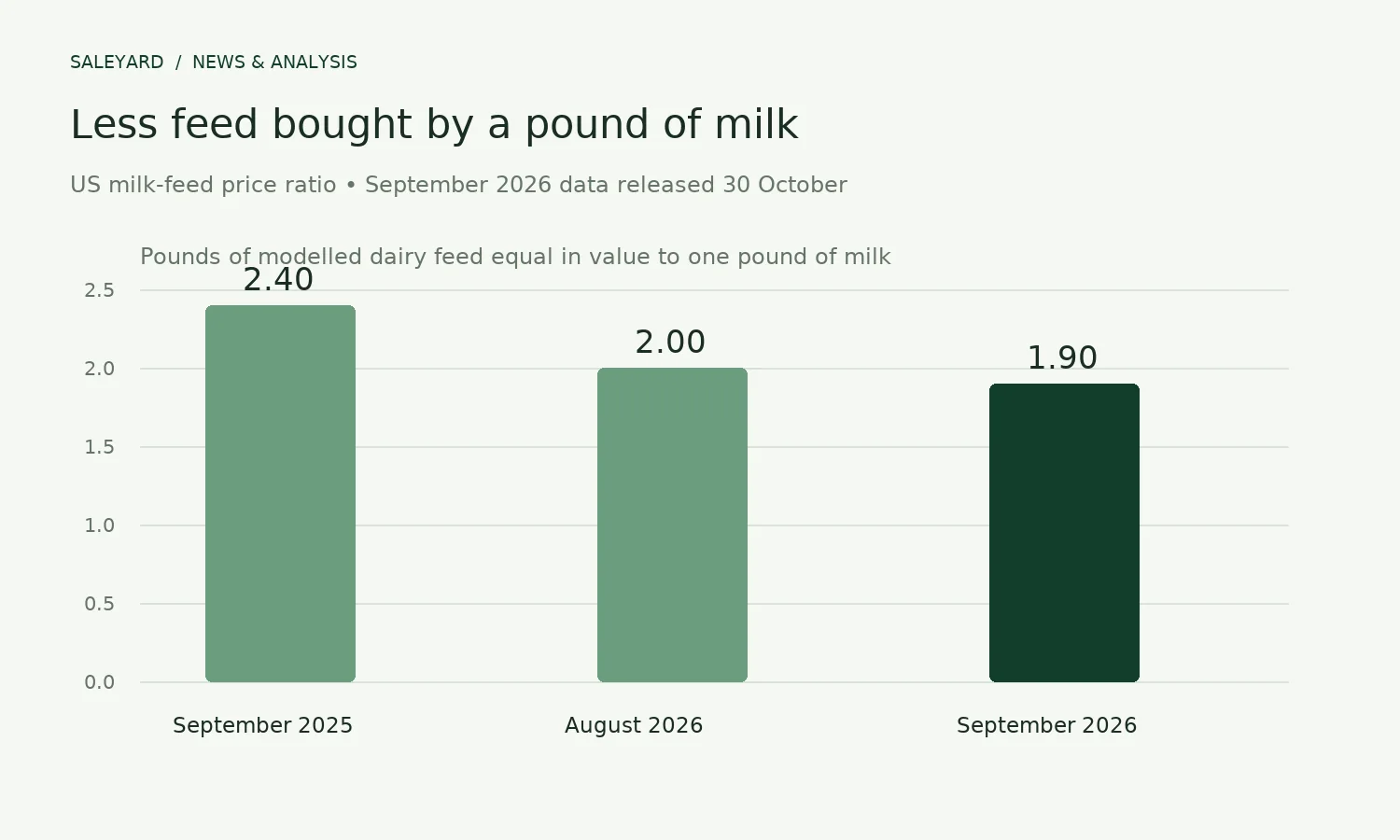
US dairy farmers faced a sharper squeeze on feed purchasing power in September than the small monthly fall in milk prices might suggest. Fresh USDA figures released on 30 October put the milk-feed price ratio at 1.90, down from 2.00 in August and 2.40 a year earlier. [1]
The ratio measures how much of a modelled dairy feed a pound of milk can buy. September’s reading was about 21% below September 2025. That does not mean US farm profits fell by 21%, but it exposes a cost relationship that the milk-price headline alone would miss. [1]
For New Zealand farmers, there are two reasons to watch: pressure on the economics of an overseas dairy supplier, and a familiar warning about the cost of producing extra milk. Neither supports an automatic change to a NZ payout budget.
A small milk-price fall hides a wider gap
The US all-milk price was US$19.50 per hundredweight in September, against US$19.80 in August and US$20.40 in September 2025. This is a US raw-milk measure, before haulage deductions, quoted per 100 pounds. It is not comparable with a NZ milk-company price per kilogram of milksolids. [1]
View chart data
| Period | Milk-feed price ratio (lb feed per lb milk) |
|---|---|
| September 2025 | 2.4 |
| August 2026 | 2 |
| September 2026 | 1.9 |
USDA’s ratio prices a standard feed mix containing corn, soybeans and alfalfa. It is a consistent comparison of milk and feed prices, rather than an account of what every farm feeds or spends. Debt servicing, labour and other farm costs sit outside that calculation. A lower reading identifies weaker purchasing power; it does not establish whether an individual business is losing money. [1]
Pressure on US farms is a market clue
The United States participates in international dairy trade, as USDA’s Economic Research Service documents in its dairy trade series. That makes conditions on American farms relevant beyond their domestic milk market. The important question for NZ is whether those conditions eventually change the volume and mix of products competing for buyers. [2]
This report does not answer that question. It records prices for September, not a forecast of future American milk production, cow numbers or exports. A margin squeeze could affect production decisions, but treating the ratio as proof that US supply is about to fall would skip the evidence needed to support that conclusion.
For a NZ farmer, the next useful checks are actual milk output and export product availability, alongside the prices buyers are paying for powder and fat. The timing matters: a past month’s farm economics can help explain decisions without telling us when, or whether, those decisions will appear in internationally traded supply.
Fonterra’s published milk-price methodology provides a separate bridge to NZ returns. It uses revenue from reference commodity products, exchange rates and specified costs. A fall in US raw-milk prices is therefore no substitute for following those ingredients in the NZ calculation. [3]
The closer-to-home lesson is the marginal litre
DairyNZ’s existing work on marginal milk offers a useful local comparison. It explains why the return on extra supplement depends on the additional milksolids produced, with pasture substitution and wastage affecting the result. That research is background guidance, rather than a new finding from this American release. [4]
The relevant farm calculation is the value of that extra production after the costs required to obtain it. Cheaper feed can still be expensive if the milk response disappoints. Conversely, a higher feed price may be justified where it fills a genuine deficit and produces an adequate return. A national overseas price ratio cannot make that decision for a NZ pasture system. [4]
The fresh US figures add a warning about the space between revenue and production costs. The international supply response remains one to watch; the immediate NZ question is whether the next unit of feed will earn more than it costs.