

American buyers have paid more for imported beef, with stronger demand for Australian and New Zealand product helping lift the market in USDA’s 30 October trade report. For NZ cattle farmers, it is an encouraging export signal, although the same report contains a reason to keep expectations measured: trading was light. [1]
The US agency described prices as mostly moderately to sharply higher compared with the previous market test. Its explanation was direct: “Stronger demand, especially for Australia/New Zealand product, supported import prices.” That links the improvement to a market NZ exporters actually serve, rather than to an unrelated overseas cattle indicator. [1]
The price signal comes with a volume question
For the near-term East Coast window, 95% bull meat was reported at US$362–365 per hundredweight and 90% cow meat at US$341–344. The graphic separates those products from other specifications, because a higher price for one type of beef does not establish an equivalent lift across the carcase. The report groups Australia and New Zealand together; it does not identify a separate NZ selling price. [1]
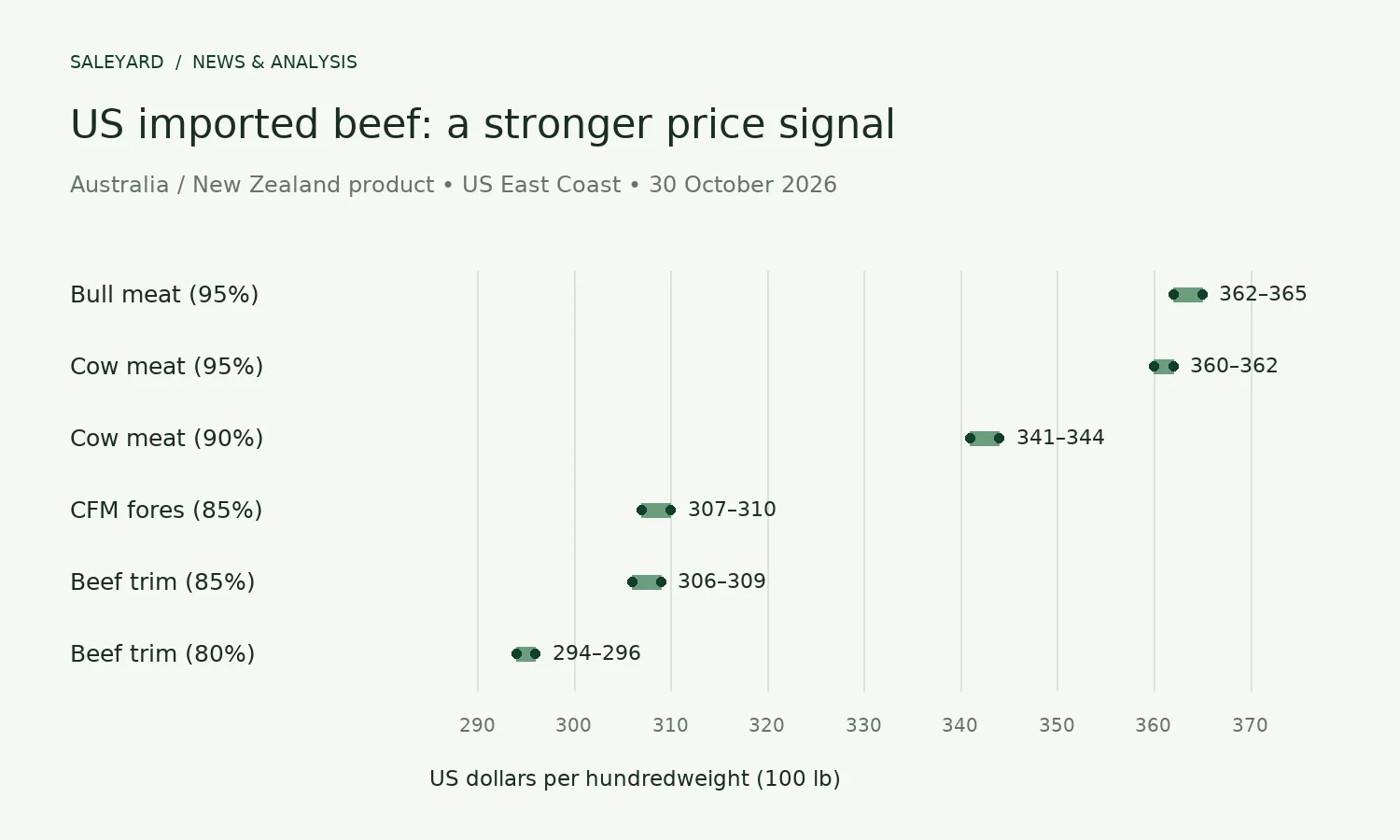
View chart data
| Product | Low (US$/cwt) | High (US$/cwt) |
|---|---|---|
| Bull meat (95%) | 362 | 365 |
| Cow meat (95%) | 360 | 362 |
| Cow meat (90%) | 341 | 344 |
| CFM fores (85%) | 307 | 310 |
| Beef trim (85%) | 306 | 309 |
| Beef trim (80%) | 294 | 296 |
Light trading matters when interpreting a price rise. A stronger level established on limited business is useful evidence of buyer interest, but gives less assurance about the price available across a large sale programme. The next test is whether demand holds as more product is offered. That is a question for subsequent reports, rather than something this release can settle. [1]
It also leaves a distinction between the direction of the market and the size of a farmer’s eventual benefit. The report supplies ranges for specified imported products and delivery windows. It does not publish a percentage increase in NZ farmgate returns, or a volume-weighted average for all NZ beef. Calculating a cattle-price uplift from the top of one range would give the numbers a meaning they do not have. [1]
Why the US signal matters here
The scale of the connection is visible in earlier NZ export figures. In its September release covering August, the Meat Industry Association recorded NZ$155 million of beef exports to the United States, the largest destination within a NZ$403 million beef total. Those are background figures, not a new October result, but they explain why a change in US buying conditions warrants attention on NZ farms. [2]
There are several steps between an overseas product price and a processor’s offer for an animal. A farmer assessing the news needs to ask which specification improved, how that product fits the animal being sold, and what the processor is offering for the relevant class and weight. A bull-meat quote cannot simply be attached to every steer or heifer on the farm.
Currency and units also need care. These figures are US dollars per 100 pounds of product, on the report’s F.O.B./T.I.S. basis. NZ processor schedules use NZ dollars per kilogram of carcase weight. A weight conversion alone would still leave different products, costs and commercial terms; it would not produce a comparable schedule. [1]
The useful follow-through is a confirmed offer
For a farmer deciding whether to sell now or carry stock longer, the practical comparison remains the confirmed sale value against the extra feed, time and weight gain involved in holding those animals. The US report strengthens the demand side of that discussion. It does not establish what another fortnight of grazing will earn.
A useful follow-up would be a repeat of the firmer tone with more business behind it, followed by evidence in the relevant NZ buying offers. Until then, the news is a stronger export-market signal with a clearly stated limit: buyers were more supportive, but the volume test is still to come.