America’s latest dairy outlook presents a divided market for New Zealand farmers to watch: stronger milk-powder values, but weaker butter and cheese forecasts. USDA’s Economic Research Service report, released on 16 October, sets out why a better headline milk-price forecast does not mean every dairy product is strengthening. [1]
Its 2027 forecast for nonfat dry milk is US$1.74 a pound, 19 cents above the previous projection. Butter moves the other way, down 7.5 cents to US$1.55 a pound. Cheddar cheese is also lower. The split matters to NZ because the products competing in export markets are moving at different speeds. [1]
Powder and milk fat are telling different stories
The report describes robust demand for dairy protein products. For 2026, USDA has raised its nonfat dry milk and dry whey price forecasts while reducing those for butter and Cheddar, citing ample supplies of the latter two products. Its October outlook analyses the changes in the 9 October World Agricultural Supply and Demand Estimates; these are forecast revisions, rather than new auction results. [1]
For 2027, dry whey is forecast at US71.5 cents a pound, up 2.5 cents, while Cheddar is forecast at US$1.615, down 3 cents. Nonfat dry milk receives the largest upward revision among those four products. [1]
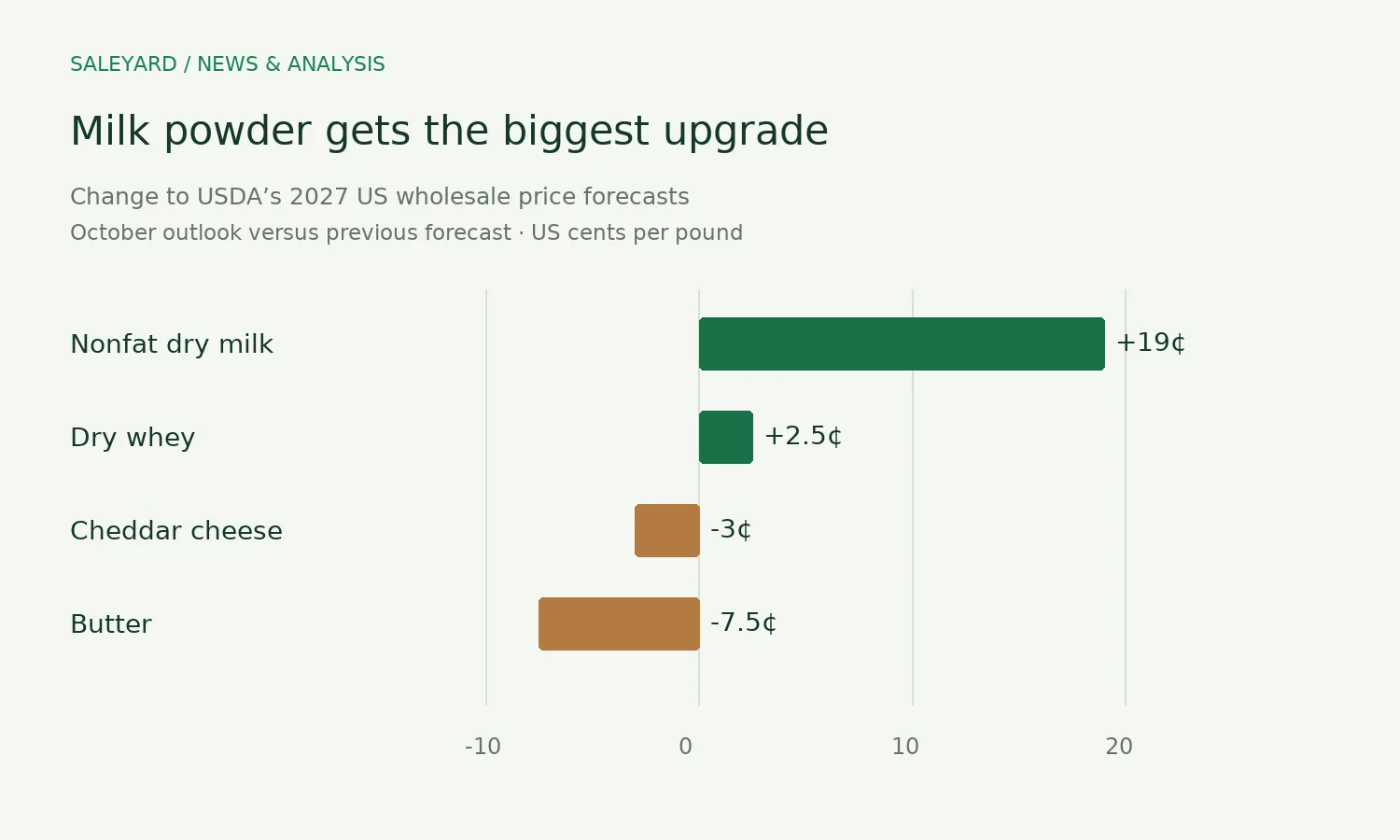
View chart data
| Product | Previous forecast (US$/lb) | October forecast (US$/lb) | Revision (US cents/lb) |
|---|---|---|---|
| Nonfat dry milk | 1.55 | 1.74 | 19 |
| Dry whey | 0.69 | 0.715 | 2.5 |
| Cheddar cheese | 1.645 | 1.615 | -3 |
| Butter | 1.625 | 1.55 | -7.5 |
Nonfat dry milk belongs to the skim-milk-powder side of the market. It should not be confused with whole milk powder, and the US price is not a Global Dairy Trade result. A stronger forecast for one powder does not establish an equal increase across NZ’s dairy export basket.
More US milk, even after the forecast trim
USDA now expects US milk production of 236.9 billion pounds in 2026 and 238.4 billion pounds in 2027. Those forecasts are lower than its previous estimates by 0.3 billion and 0.2 billion pounds respectively. Yet the latest figures still imply production growth between the two years of about 0.6%. [1]
That is a useful distinction when assessing competition. A downward revision is less milk than forecasters previously expected; it is not necessarily less milk than the previous year. NZ exporters cannot treat a small forecast reduction as evidence that an overseas competitor is retreating.
Nor does total milk volume identify how much of each product will reach export markets. Domestic consumption, manufacturing choices and inventories sit between milk production and the volumes available to international buyers.
The trade forecasts provide a second signal
For 2027, USDA has raised expected US dairy imports on a milk-fat basis to 8.8 billion pounds of milk equivalent, 0.3 billion higher than before, with stronger expected butter and milk-powder imports behind the revision. It has reduced expected exports on the same basis to 20.1 billion pounds, down 0.2 billion. [1]
These milk-equivalent measures express dairy products in terms of the milk associated with their components. They are not tonnes of butter or powder. They also do not allocate any additional American buying to New Zealand: other suppliers, prices and market access still determine who wins an order.
For NZ, the combination is nevertheless more useful than a single US milk-price number. It points to a market where opportunities to sell into the US and competition from US exports need to be examined product by product. It is a signal about the competitive setting, rather than a confirmed lift in NZ export receipts.
What carries through to a New Zealand milk cheque?
USDA’s 2027 all-milk price forecast rises by US65 cents to US$20.45 per hundredweight. That is a US milk measure, not NZ dollars per kilogram of milksolids. Applying its percentage change to a Fonterra payout would create a comparison the report does not support. [1]
Fonterra’s published 2026/27 forecast range remains NZ$8.50–$10.50/kgMS, dated 21 September. The American outlook does not announce a change to that range. Its relevance is the evidence it supplies about individual products and a major competing producer. [2]
For farmers following international dairy markets, the next useful test is whether stronger powder demand continues into actual sale prices and exporter returns, while weaker fat prices offset part of the gain. The October outlook gives grounds to watch protein closely. It does not give every kilogram of milk the same lift.