.jpg)
American beef production fell in the latest weekly figures, giving New Zealand exporters another reason to watch the US supply balance closely. The important detail is that heavier cattle did not make up for fewer animals going through processing plants. [1]
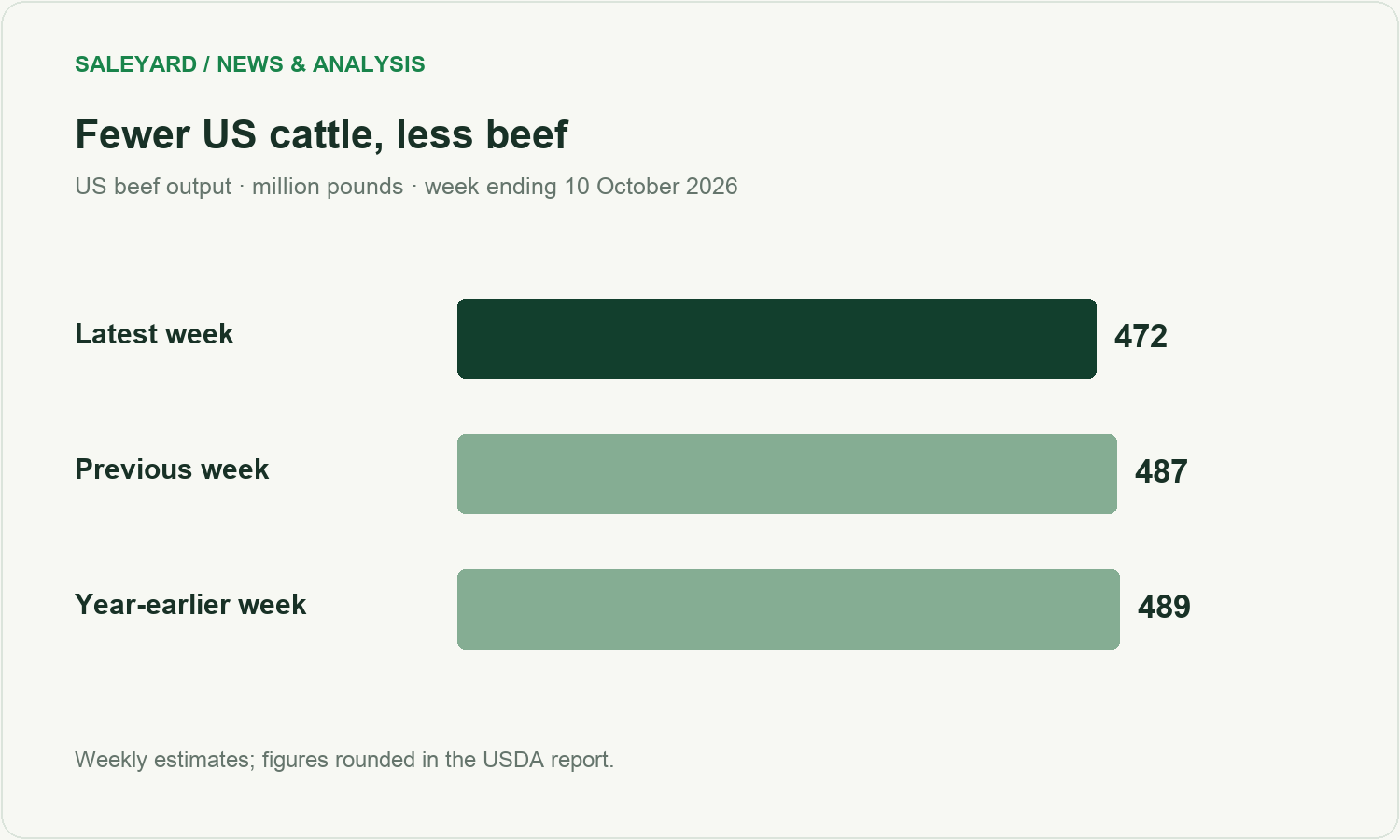
USDA’s 12 October daily summary put beef output for the week ending 10 October at 472 million pounds, against 487 million the previous week and 489 million a year earlier. Those rounded estimates imply falls of about 3.1% and 3.5%, respectively. [1]
View chart data
| Period | Beef production (million lb) | Slaughter (head) | Dressed weight (lb) |
|---|---|---|---|
| Week ending 10 October 2026 | 472 | 531000 | 891 |
| Previous week | 487 | 548000 | 890 |
| Year-earlier comparable week | 489 | 551000 | 888 |
Estimated slaughter was 531,000 head, down from 548,000 a week earlier and 551,000 in the comparable year-earlier week. Average dressed weight was slightly higher, at 891 pounds versus 890 and 888 pounds. The extra weight softened the effect of the lower kill, but did not cancel it. [1]
The opportunity is in the product America needs
That matters to New Zealand because the export opportunity is more specific than a general shortage of beef. In its September conference report, Beef + Lamb New Zealand highlighted American demand for imported lean beef and the value of dependable NZ supply. That is background to this week’s release, rather than a new export forecast. [2]
A shortage in one part of the American supply chain does not lift every product equally. An exporter selling lean manufacturing beef is serving a different customer and specification from a business supplying premium table cuts. The useful commercial question is which products buyers need, in what volumes and at what price.
Lower domestic output can make imported supply more valuable at the margin. But it does not tell us how many orders New Zealand exporters have secured, what they have paid for livestock, or what the next processor schedule will be. Those require their own evidence. The USDA release measures American supply; it is not a New Zealand price announcement.
One week is a signal, not a herd count
Weekly slaughter can move with processing schedules, the timing of cattle deliveries and other short-term factors. It cannot by itself establish whether the national herd has shrunk again. Herd inventories, placements and slaughter describe different stages of the production system. Treating them as interchangeable would overstate what this report shows.
The comparison is still useful. It tests whether heavier animals are compensating for a lower head count. Here the change in carcass weight was small, while the decline in animals processed was larger. The weekly output figure consequently moved down. Sustained repetition would be more convincing evidence of a tightening supply position than one observation.
USDA also reported a higher daily Choice boxed-beef cutout, at US$375.56 per hundredweight, up US$2.21; Select edged lower to US$354.13. These are wholesale indicators for specified US beef categories, rather than NZ farmgate prices. Their different movements underline why product mix matters. [1]
What reaches the farm is the export margin
For a New Zealand finishing business, the route from a US market signal to an on-farm return runs through the exporter’s selling price, currency exposure, product mix and operating costs. Competition for local cattle also matters. An improved overseas selling opportunity may support procurement, but the size and timing of that support cannot be read straight from an American report.
Farmers weighing a sale or replacement-stock purchase therefore need two separate views: the export market’s direction and the margin in their own transaction. A firmer demand backdrop is useful. It does not remove the cost of buying the next animal, carrying it through the farm or meeting a buyer’s specification.
The next useful check is whether the fall in US output persists and whether buying interest in the relevant imported products strengthens alongside it. This week’s figures show that extra carcass weight was not enough to hold production steady. For NZ suppliers, that is a market development worth following without turning it into a promised price rise.