
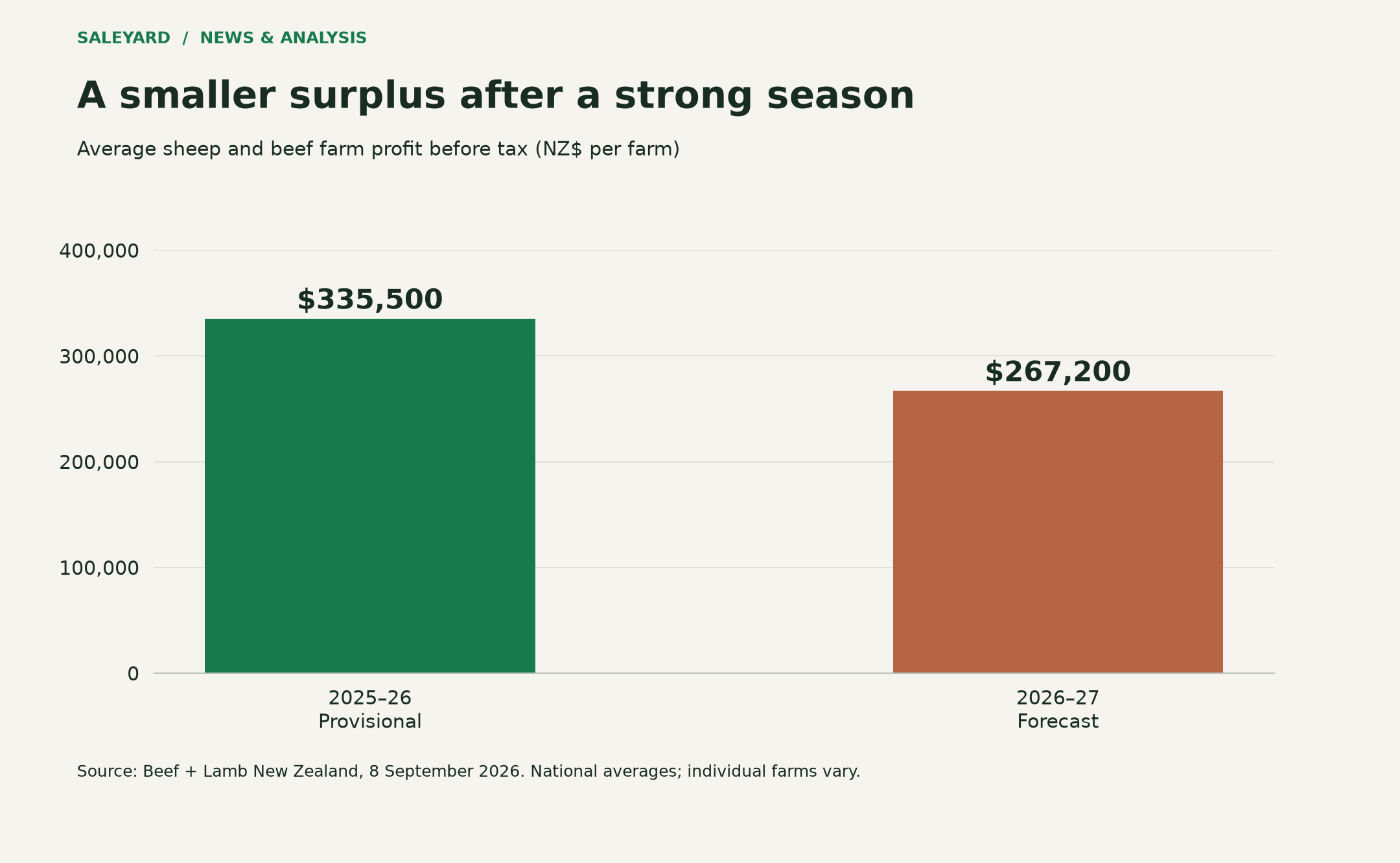
New Zealand sheep and beef farmers are heading into a season in which livestock can still sell well and the business can finish with considerably less money left over. Beef + Lamb New Zealand’s September outlook forecasts average farm profit before tax of $267,200 in 2026–27, against a provisional $335,500 this season. That is a reduction of $68,300, or about 20%. [1]
The starting point matters. The forecast follows an exceptional recovery and remains above the five-year average. B+LNZ expects farmgate cattle prices to ease 4.5% and lamb prices 8%, while farm expenditure rises 4.2%. The concern is the amount retained after the bills, even while livestock returns remain strong. [1]
View chart data
| Season | Status | NZD per farm |
|---|---|---|
| 2025–26 | Provisional | 335500 |
| 2026–27 | Forecast | 267200 |
Profit is particularly sensitive when revenue and costs move in opposite directions. Consider a purely illustrative business earning $1 million and spending $700,000. If revenue falls 4% and expenditure rises 4%, its $300,000 surplus becomes $232,000: a fall of almost 23%. Small percentage movements across the whole business can make a large difference to what remains. Those example amounts are not B+LNZ’s farm forecast.
The full outlook identifies fertiliser, lime and seeds as a major pressure: spending is forecast to rise 14.5% to $144,800 per farm. Interest and rent, by contrast, are broadly steady. The report also assumes the New Zealand dollar averages US61 cents, compared with US58 cents for 2025–26. [2]
The national average also conceals sizeable regional differences. B+LNZ forecasts East Coast farm profit at $244,400, down 27%, while Taranaki–Manawatū eases 10% to $233,200. The East Coast faces a larger rise in expenditure, including fertiliser and recovery work. The western region has a more supportive production outlook. These are regional averages, not predictions for every property. [2]
That currency change deserves attention alongside the schedule. For an unchanged US$100 sale, conversion at US58 cents produces NZ$172.41; at US61 cents it produces NZ$163.93. That is about 4.9% less in local currency before hedging, processing or other costs. This calculation illustrates exchange-rate exposure; it does not imply a matching reduction in every farmer’s price.
Exporters sell a range of products into several currencies, and contracts and hedging can delay the effect. A stronger dollar can also make imported inputs cheaper. The useful question is how the two sides of a particular business balance, rather than assuming currency movements pass straight through to the farm gate.
Rabobank’s September assessment provides some support for confidence in beef. It points to restricted global supply and firm demand, while identifying easing US manufacturing-beef values and changing Australian and Brazilian trade flows as risks. Its input-market assessment is mixed too: international nitrogen prices softened in August, while phosphate remained firm. [3]
A cheaper international fertiliser quotation therefore cannot be treated as a reduction across the entire farm budget. Product choice, freight, timing and existing purchases determine what the farm actually pays. Likewise, a good export market does not remove the need to check the margin on the next cattle purchase.
For a breeder, stronger young-stock prices lift the value of animals produced on the farm. For a finisher, those same prices raise the cost of securing animals to carry through to slaughter. The two businesses sit on opposite sides of the same transaction. Both can benefit from strong beef demand, but their exposure is different.
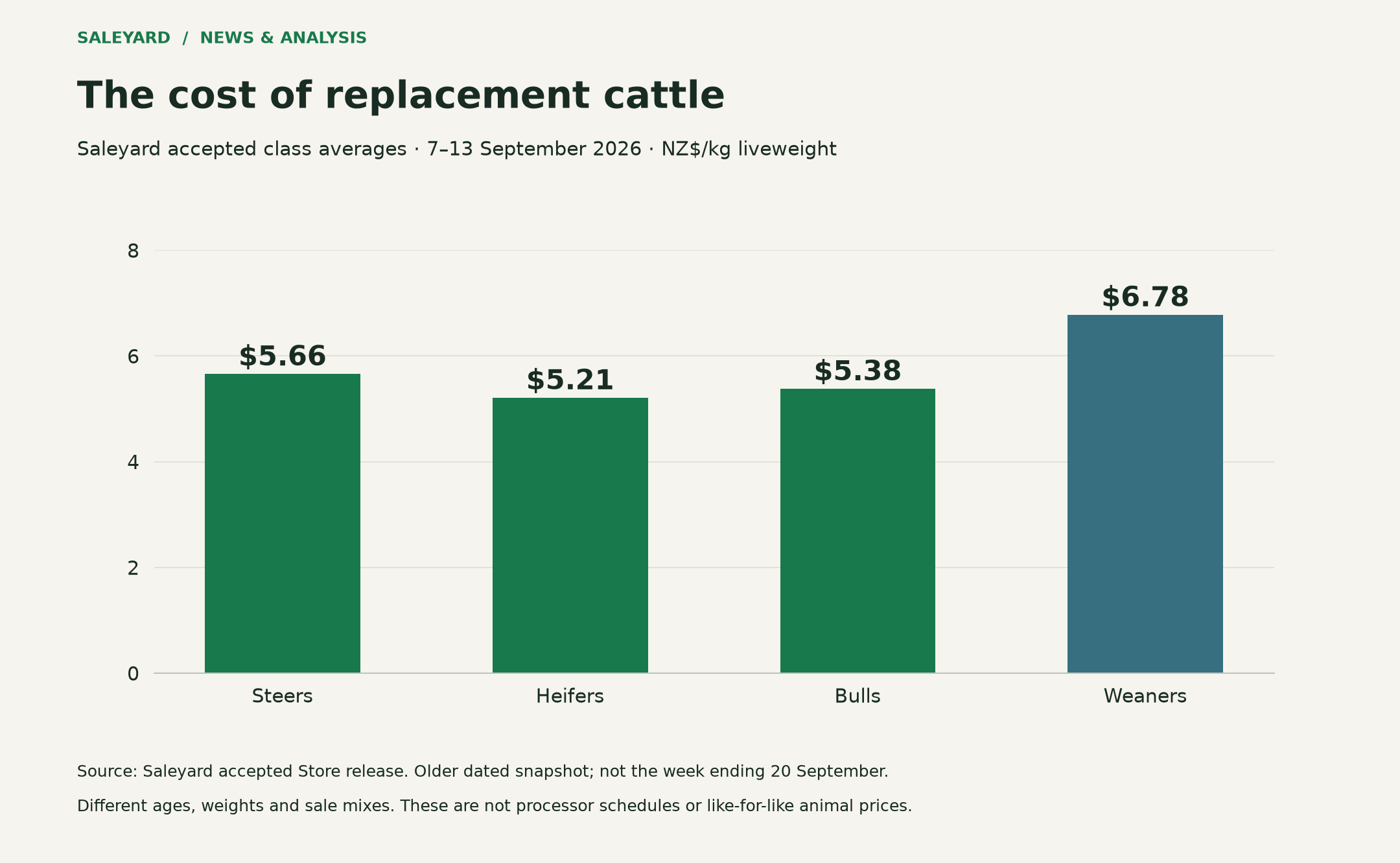
Saleyard’s accepted data for 7–13 September puts its steer class average at $5.66/kg liveweight and heifers at $5.21. These are broad class averages across the recorded Store sale mix, not quotations for a specified animal. They are a dated September reference, not figures for the week ending 20 September. [4]
View chart data
| Class | NZD/kg liveweight | Sold head |
|---|---|---|
| Steers | 5.66 | 3663 |
| Heifers | 5.21 | 2968 |
| Bulls | 5.38 | 808 |
| Weaners | 6.78 | 321 |
The price per kilogram is only the start of a buying decision. Animal weight determines the cheque written; expected growth determines how long capital and pasture are committed; the eventual carcass weight and sale terms determine revenue. Comparing a liveweight purchase price directly with a carcass-weight schedule skips much of the business calculation.
Take an illustrative 350kg store steer bought at $5.50/kg liveweight: the purchase costs $1925. A later sale at 320kg carcass weight and $9/kg would return $2880, leaving $955 before grazing, animal health, finance, freight, selling costs and losses. These are example assumptions, not current quotations or a forecast of growth.
Paying another 50 cents per kilogram at purchase removes $175 from that allowance. A 50-cent reduction in the eventual carcass price removes a further $160. Together, those changes reduce it to $620 before any additional feed bill. Strong headline prices can therefore sit alongside a much less forgiving trade.
There is a second distinction behind the national profit figure. B+LNZ defines farm profit before tax after working expenses, standing charges, interest, rent and depreciation. Tax, personal drawings, principal repayments and capital purchases still have to be funded. The headline amount is not a household spending allowance. [5]
Nor is profit identical to cash in the bank. Depreciation is an accounting expense without a matching current cash payment; repaying loan principal uses cash without being an operating expense. Replacing machinery can absorb cash in a profitable year. A profit forecast and a cashflow forecast answer different questions, and a farm needs both.
Comparisons between farms also need care. B+LNZ’s profitability calculator explains how debt and leasing arrangements alter reported profit even when underlying farm performance is similar. Comparing operating earnings before interest and rent helps separate the performance of the farming system from the way it is financed. [6]
This is why a blanket instruction to cut expenditure would miss the point. Maintenance deferred during a poor season eventually comes due. Fertility, reliable water and sound infrastructure can support future production. The assessment is whether spending protects or improves the business enough to justify its cost, and whether the timing fits available cash.
At an August B+LNZ workshop in North Canterbury, accountant James Nell of Leech and Partners urged farmers to take a longer view. “Tax should not be the main driver of decisions,” he said, according to B+LNZ’s account. The workshop also emphasised understanding expenditure and using profitable years to strengthen the farm. [7]
For the coming season, that means testing a budget against softer sale prices, dearer replacement animals and slower growth as well as the central forecast. A useful cattle budget shows the purchase cost per head, the expected sale month and weight, and the costs incurred between them. If the margin depends on every assumption going right, the apparent strength of the market offers limited protection.
September’s outlook still leaves room for debt repayment and worthwhile investment. The discipline is to decide how much of the recent recovery can safely be committed before the next season has earned it. A good price rewards the animal sold; a durable surplus depends on the cost of producing and replacing it.