

The Reserve Bank has held the Official Cash Rate at 2.75%, but the narrow vote offers little comfort to farmers treating the pause as an all-clear on borrowing costs. Four Monetary Policy Committee members backed the hold on 28 October; three wanted a quarter-percentage-point increase to 3%. [1]
For a farm business, the useful question is how much debt could reprice, and when. A policy rate left unchanged does not settle the rate offered on the next loan renewal. Nor does it remove the cash requirement created when an existing fixed term ends.
A pause with a clear warning attached
Committee members agreed that “tighter monetary policy is likely to be required”, while making that judgement conditional on the economic outlook. A hold therefore leaves the possibility of a later increase in play; it does not promise one. [1]
Financial conditions were mixed. The bank reported higher domestic wholesale rates alongside declines in some term lending rates for households and businesses. That distinction matters at the farm gate: the announcement gives a policy decision, not a quote for refinancing a particular business. [1]
The exposure is the loan that actually changes
The Reserve Bank’s monetary-policy handbook explains why lending rates do not move mechanically with the OCR. Expectations about future policy, funding costs and risk premiums also matter. Borrower credit risk can affect pricing, so two businesses need not face the same margin even when the underlying market conditions are similar. [2]
That makes a farm’s loan schedule more informative than its total debt alone. Identify each balance, the rate arrangement and the next reset date. A business with most debt fixed beyond this season has a different near-term exposure from one with a large renewal approaching, even if their total borrowing is identical.
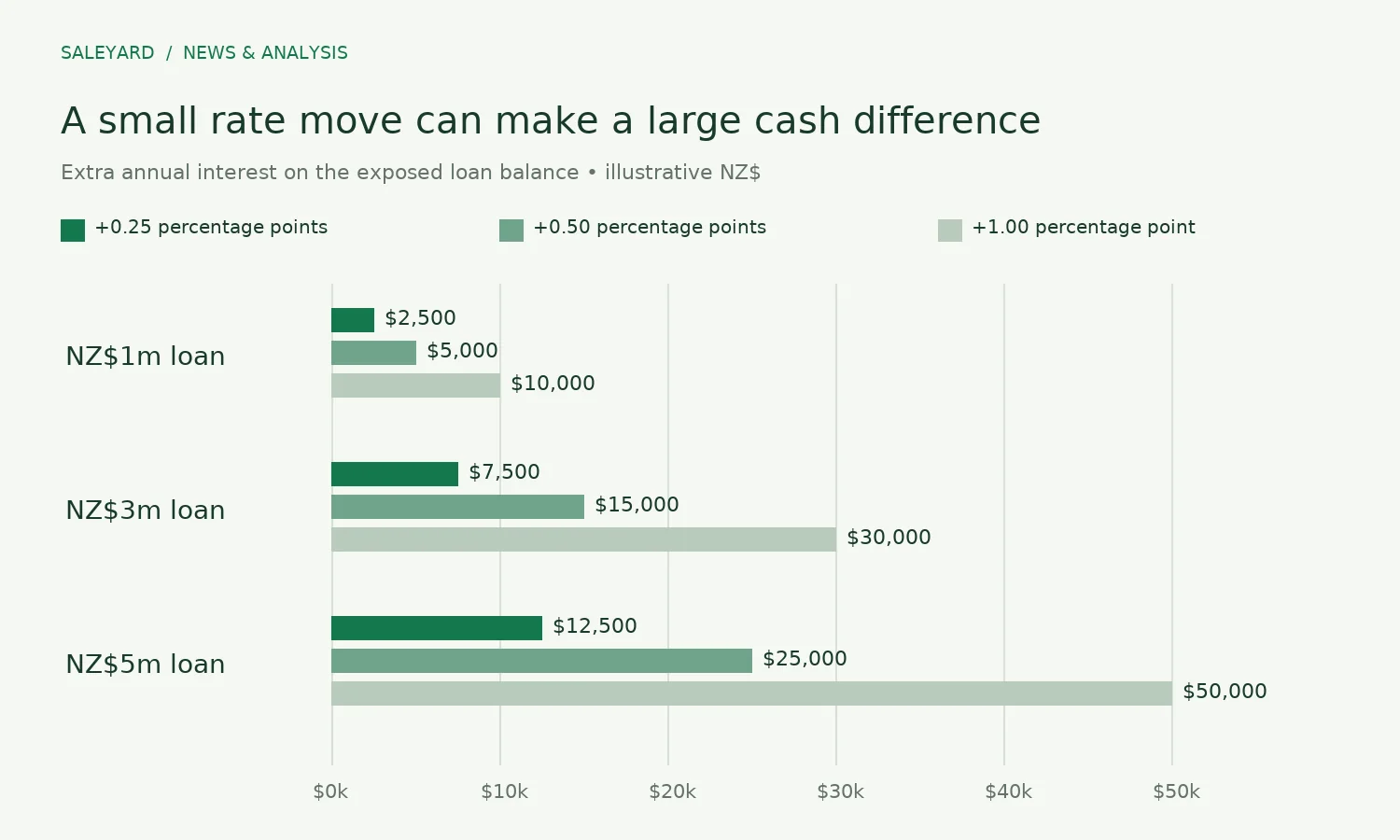
The arithmetic gives the issue scale. A 0.25-percentage-point increase on NZ$1 million exposed for a full year adds NZ$2,500 in interest. The same change on NZ$5 million adds NZ$12,500. At a one-percentage-point increase, those annual amounts become NZ$10,000 and NZ$50,000 respectively.
View chart data
| Exposed loan balance (NZ$) | Extra interest +0.25 percentage points (NZ$/year) | Extra interest +0.50 percentage points (NZ$/year) | Extra interest +1.00 percentage point (NZ$/year) |
|---|---|---|---|
| 1000000 | 2500 | 5000 | 10000 |
| 3000000 | 7500 | 15000 | 30000 |
| 5000000 | 12500 | 25000 | 50000 |
These are sensitivity calculations, not a forecast of the OCR or a bank quote. They assume the full balance reprices for a year and principal stays unchanged. If only part of the debt resets, or it resets partway through the year, the extra cash cost is correspondingly smaller. Fees, hedging and principal repayments sit outside the calculation.
Put the reset date into the monthly budget
DairyNZ’s monthly cashflow guidance makes the timing distinction explicit: spread expected income and outgoings across the year to identify shortfall months and working-capital needs. Its budgeting guidance includes milk and stock receipts, farm expenses, loan repayments and tax, rather than looking only at an annual surplus. [3]
A higher annual interest bill can be manageable in a strong receipts month and awkward when several other payments fall due. Put the actual renewal date into the budget, then compare the current offer with a higher-rate case. That shows the size and timing of any funding gap without pretending to know the next policy decision.
The same exercise helps assess whether planned spending leaves enough cash available. The relevant comparison is the additional debt service against the cash the business can generate after its other commitments. A good commodity-price headline cannot answer that question for an individual farm.
The October decision buys another period at the same policy setting. For farmers, its sharper message is in the split vote and conditional warning. The rate on the farm’s next renewal, the balance affected and the month it changes will determine what the pause is actually worth.