
New Zealand’s sheepmeat industry has taken its defence of US lamb access to Washington, with a November decision now the next major test. Beef + Lamb New Zealand said on Monday that chair Kate Acland and Meat Industry Association chief executive Nick Beeby had testified at the US International Trade Commission’s safeguard hearing. [1]
The hearing took place on 16 October, US time. Monday’s industry update is fresh; the investigation itself is already under way. No new restriction has been imposed by this hearing, and an adverse finding would not itself set a tariff. For farmers, the issue is a potential change to market access rather than a confirmed cut in the value of their next draft. [2]
The industry’s case is still a case, not a ruling
B+LNZ’s update said “our imports are not causing harm to domestic producers”. That is the New Zealand industry’s position. The commission has yet to decide the injury question, and B+LNZ acknowledged that the outcome remains uncertain. [1]
The distinction matters commercially. Strong advocacy can explain why exporters believe access should be preserved; it cannot establish what US authorities will decide. A buying or finishing calculation built on the assumption that the case has already been won would move ahead of the evidence.
November decides whether the risk moves to another stage
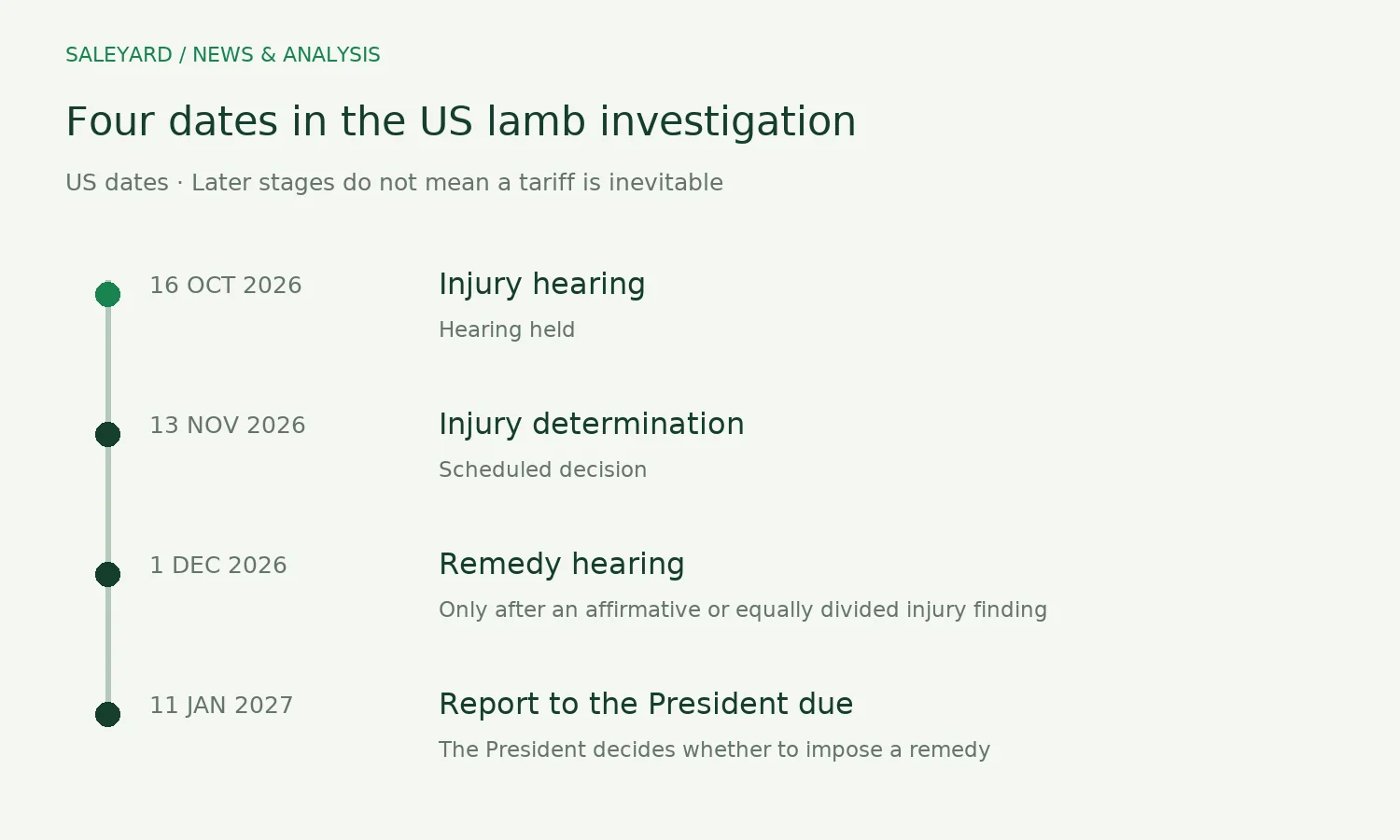
The commission is due to make its serious-injury determination by 13 November. If it finds injury, or is equally divided, a remedy hearing is scheduled for 1 December. Its report to the President is due by 11 January 2027. The President makes the final decision on any remedy. A negative injury finding ends the proceeding without a remedy phase. [2]
View chart data
| US date | Milestone | Status |
|---|---|---|
| 16 OCT 2026 | Injury hearing | Hearing held |
| 13 NOV 2026 | Injury determination | Scheduled decision |
| 1 DEC 2026 | Remedy hearing | Only after an affirmative or equally divided injury finding |
| 11 JAN 2027 | Report to the President due | The President decides whether to impose a remedy |
Possible remedies include a higher duty, a quota or a tariff-rate quota. The last combines a quantity threshold with a higher tariff above it. No rate or allocation has been established by the material reported here. Describing a particular percentage loss for NZ lamb at this point would therefore imply precision the case does not yet provide. [2]
Market access reaches the farm through the export return
The economic exposure begins with the value an exporter can realise after the costs of supplying a customer. If a trade measure increases the landed cost in the United States, someone in the chain must absorb that cost, negotiate a different price or change the trade. How much reaches the NZ exporter would depend on the eventual measure and the response of buyers and competing suppliers.
That is why a tariff percentage, if one is eventually announced, would not translate mechanically into the same percentage change in a farm-gate schedule. The tariff base, product mix, customer contracts, exchange rate and returns available in other markets would all matter. Until a measure exists, this is a pathway for risk rather than a forecast.
Nor would redirecting product necessarily preserve its value. Another market may want a different specification or pay a different price. The commercial question is the return available for the particular product displaced, after additional costs, rather than whether another destination buys lamb at all.
The next useful signal is an official decision
For a finishing business, the practical response is to keep market-access uncertainty separate from the feed and growth assumptions already in the budget. A downside sale-price scenario can show how much margin is exposed without pretending to know the case’s result. It should be a sensitivity test, not an invented forecast of a processor’s next schedule.
The next milestone is the November injury decision. After that, the questions become more specific: whether a remedy phase follows, what restriction is recommended and whether the President acts. Monday’s update shows the industry arguing its position. It does not yet tell farmers that their US market access has changed.