
A wet track, a familiar bike and a job that has been done the same way for years will no longer be enough reason to carry on. WorkSafe’s new code for farm vehicles puts a clear decision in the middle of routine work: when conditions change, pause, reassess the vehicle, route, speed and load, then change the job or stop if the risk cannot be controlled. [2] [3]
The Safe Farm Vehicle Operation approved code of practice comes into effect on 1 April 2027 alongside a second code covering roles and responsibilities in agriculture. They apply across livestock, dairy, arable, horticulture, viticulture and mixed farming. The codes do not create a new set of health-and-safety duties; they describe a recognised way to meet existing duties under the Health and Safety at Work Act. [1] [2] [4]
The timing gives farms six months to turn the documents into operating practice. That matters because the standard is more specific than a general instruction to be careful. It covers quad bikes, side-by-sides, two-wheel motorbikes, utes, four-wheel drives, tractors and attached machinery, and follows the work from planning and pre-start checks through to changing conditions and maintenance. [2] [3]
The numbers explain the emphasis on vehicles
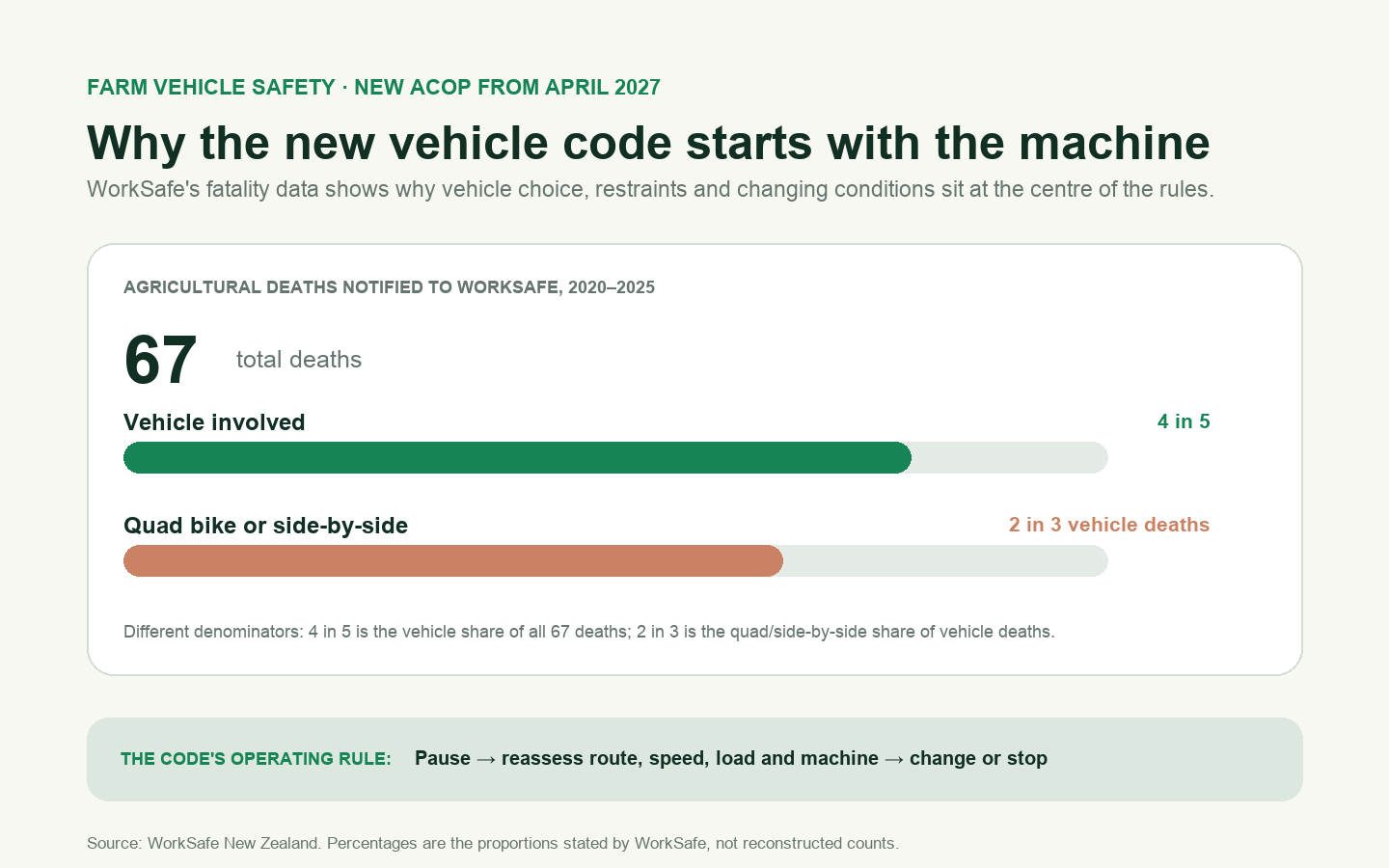
WorkSafe says vehicles were involved in four out of five of the 67 agricultural deaths notified to it between 2020 and 2025. Quad bikes and side-by-sides accounted for two-thirds of those vehicle deaths. Agriculture employs about 5% of New Zealand workers but accounts for around 25% of work-related fatalities and serious injuries, with an average of 16 deaths a year. [6] [7]
“We keep seeing the same situations. Experienced operators on familiar ground, working alone, without check-in systems or protective equipment.” [6]
View chart data
| Measure | Value | Denominator |
|---|---|---|
| Agricultural deaths notified | 67 | 2020–2025 |
| Vehicle-involved share | 4 in 5 | All 67 notified agricultural deaths |
| Quad bike or side-by-side share | 2 in 3 | Vehicle-involved deaths |
The code’s central idea is that suitability belongs to the task and the day, not to the vehicle’s place in the shed. Before work starts, the farm should consider terrain, slope, ground condition, weather, visibility, people, animals, operator capability, fatigue, load and towing. If several machines could do the job, the code says to use the one that provides the highest protection against serious injury for those conditions. [3]
Protection is a system, not one accessory
The practical requirements are direct. Seatbelts are to be worn whenever they are fitted. Operators of quad bikes, side-by-sides and two-wheel motorbikes are to use approved protective helmets. Loads must stay within manufacturer limits, remain low and evenly distributed, and be secured. Passengers belong only in fitted seats with restraints, and children must be separated from vehicle movements unless the vehicle, task and supervision are appropriate. [3]
For tractors, a rollover protective structure and seatbelt work together: the structure creates a protective space and the belt keeps the operator inside it. For a side-by-side, WorkSafe describes the combination of rollover protection, helmet and seatbelt as the primary protection in a rollover. None of those controls makes unsuitable terrain, an excessive load or a fatigued operator safe. [3]
The daily check is therefore more than fuel and tyres. The code covers brakes, steering, restraints, guards, attachments, warning devices and the operating area. A fault that affects safe operation takes the vehicle out of service until someone with the right skill and knowledge repairs or assesses it. That can create a short-term cost in workshop time or delayed work, but it removes the informal calculation that a known fault can be carried for one more job. [3]
Contracting out the job does not contract out the duty
The companion roles-and-responsibilities code is important whenever contractors, sharemilkers, suppliers or installers work on the same property. A task can be delegated, but a legal duty cannot. Where duties overlap, each business remains responsible for what it can influence and control, and the parties must consult, cooperate and coordinate. [4] [5]
On a practical farm, that means the pre-job conversation needs to carry real information. The farmer may know the soft crossing, overhead line, stock movement or change in track condition. The contractor may control the machine, operator and work method. The code expects both sides to agree on the plan, communicate changes and pause if the circumstances no longer match what was agreed. [4] [5]
The amended framework distinguishes between small and large businesses when duties overlap. The roles code says a business with fewer than 20 workers must cooperate with other businesses for critical risks, while a business with 20 or more workers must do so for all relevant risks. Commercial agreements can still require a small business to cooperate more widely, but they cannot sign away duties imposed by law. [5]
For most family farms, the sensible response is not to debate the boundary of every minor risk. It is to identify the small number of jobs where the consequence is severe — vehicle rollover, run-over, collision, entanglement or contact with overhead power — and make responsibility clear before the contractor starts. The greater the risk and the more people who can influence it, the less defensible an informal assumption becomes. [5] [3]
Safe harbour is useful, but it is not automatic yet
Following an approved code is not compulsory; a business can meet its duties another way if that approach reaches at least the same standard. The intended advantage is certainty. Under the amended law, following every relevant action in a code for a particular risk can provide a safe harbour, meaning the duty holder is treated as having complied with that duty. [2] [4]
There is an important qualification. Because these two codes were approved before the legislative changes take effect, they do not yet carry safe-harbour status. They will need to be reapproved after 1 April 2027. Until then, following them is evidence of compliance rather than an automatic safe harbour. [2] [4] [1]
What a farm can settle before April
The preparation job is manageable if it begins with actual work rather than a new folder. Farms can map which vehicles are used for which tasks, check that restraints and rollover protection are present and serviceable, record manufacturer limits, identify routes that become unsafe in wet or low-visibility conditions, and make the stop-work trigger part of staff and contractor briefings. [3] [5]
Training and maintenance records still matter because they show the system is being used, but the code’s test is operational. The right question is whether a worker facing softer ground, a heavier trailer or fading light knows when to change the machine, change the route or stop. If that answer is clear before 1 April, the farm will have done more than update its paperwork. [3]