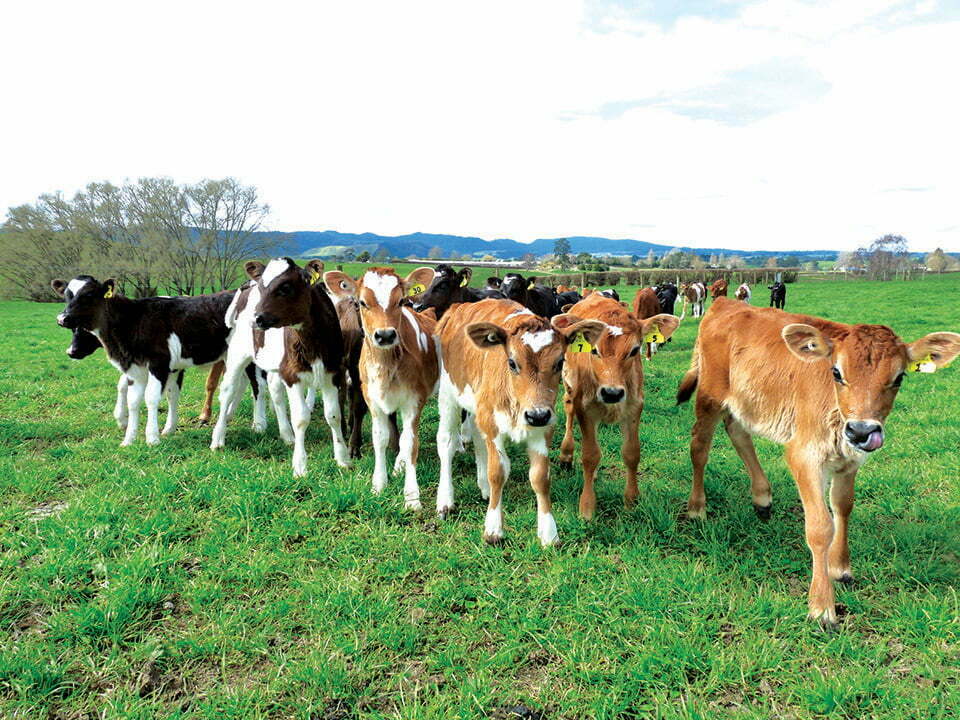
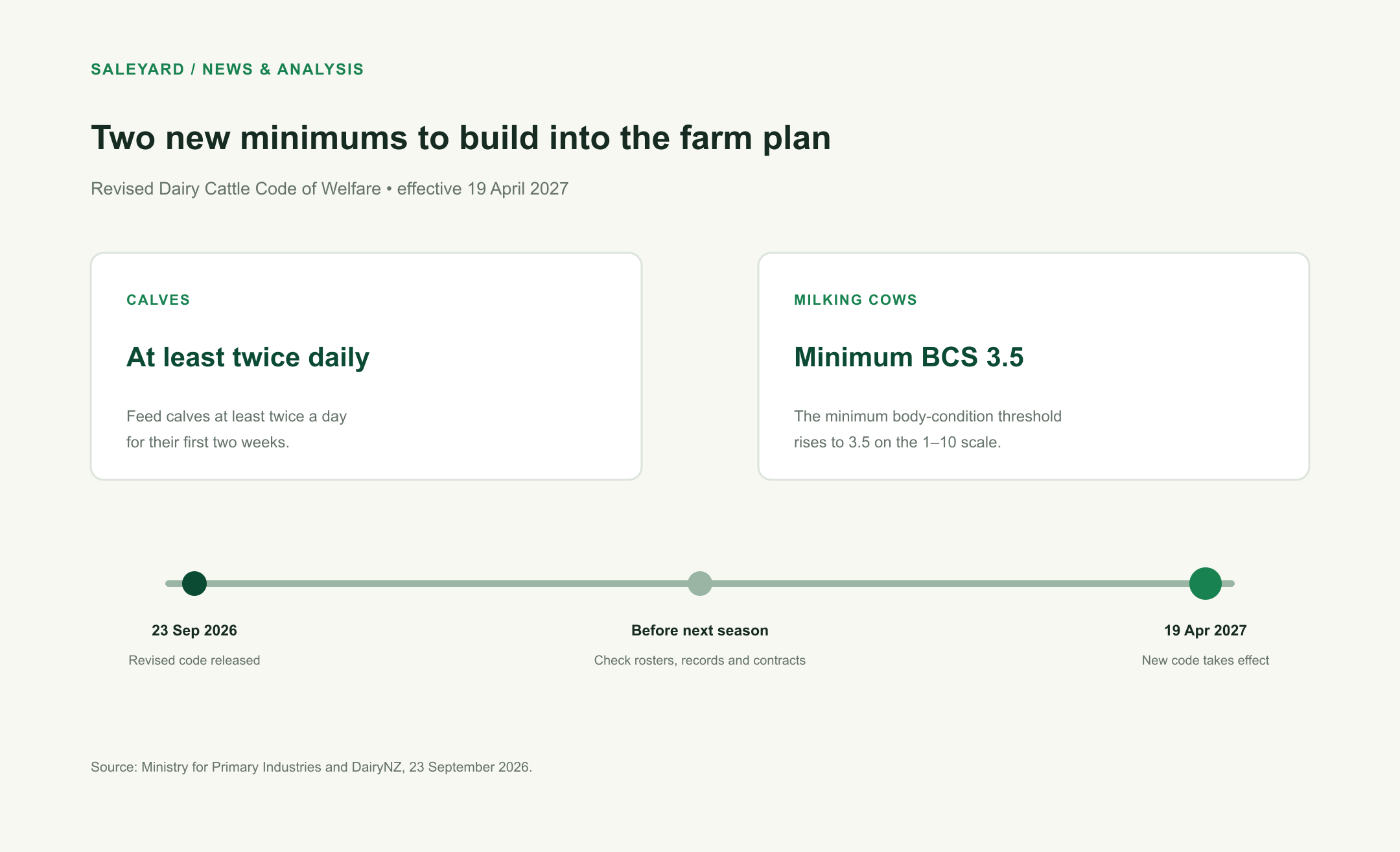
Dairy farmers have until 19 April 2027 to meet a revised Code of Welfare, but the useful preparation window is before next season’s calf shed is busy. Two changes deserve the first attention: calves must be fed at least twice a day for their first two weeks, and the minimum body-condition score for milking cows rises from 3 to 3.5 on the 1–10 scale. [1] [2]
The code was released on 23 September and replaces the existing dairy cattle code from 19 April. That gives farms time to test whether their normal practice, labour plan and records consistently deliver the new minimums. DairyNZ says most farmers already operate in line with the updated code, while acknowledging that calf-rearing practice will change on some farms. [2] [3]
View chart data
| Requirement | Confirmed new minimum | Effective date |
|---|---|---|
| Calf feeding | At least twice daily for first two weeks | 19 April 2027 |
| Milking cow body-condition score | Minimum 3.5 on 1–10 scale | 19 April 2027 |
“Farmers take great pride in caring for their livestock, and our focus now is supporting them with clear information and practical tools to put the new requirements into practice.” [3]
The calf rule is a systems test
“Twice daily” sounds simple. In practice, it has to remain true on the busiest mornings, across weekends, during staff leave and when calves are being reared away from the dairy platform. A farm that already feeds more frequently may need little operational change. A farm relying on a different routine has to redesign it before the code takes effect. [1]
The scope is wider than calves kept by the dairy farmer. MPI says the dairy code covers calves born from dairy cows until weaning wherever they are reared, along with unweaned dairy calves sent for slaughter. The person in charge of the animals at each stage needs to understand which code applies. Once cattle are weaned and being raised for beef, they fall under the sheep and beef cattle code instead. [2]
That makes off-farm rearing arrangements part of the preparation. Written agreements should make feeding expectations, collection timing and the handover of animal information clear. A contract cannot transfer away the welfare obligations of the person actually in charge, but it can reduce the gaps that arise when each party assumes the other is covering a task.
The practical audit starts with a 14-day roster. For each feed, identify who is responsible, who covers an absence and how completion is recorded. Then check whether milk or milk replacer storage, mixing capacity, feeding equipment and cleaning time can handle the busiest likely day. DairyNZ’s existing calf resources cover colostrum, feeding, housing and health management; the revised code remains the legal source for the minimum standard. [4] [2]
Records should support the system rather than become a paperwork exercise. A simple pen-level sheet or digital entry can show that the twice-daily routine occurred and flag calves needing extra attention. The record is most useful when it helps the next person know what has happened, rather than being completed later from memory.
A higher condition floor changes the trigger point
The second headline change raises the minimum body-condition score for milking cows from 3 to 3.5. The important operational point is timing. Condition cannot be restored instantly once a cow reaches the new floor; feed, health, lactation stage and the time available to recover all affect the response. [1]
A herd average can also conceal the cows closest to the threshold. The code’s minimum applies to animals, so the farm check needs to find the tail of the distribution as well as describe the herd. Cows losing condition faster than expected require attention before they become a compliance problem.
That suggests three checks: whether scoring is consistent between people, whether the frequency of scoring finds deterioration early enough, and whether the farm has a realistic response for at-risk cows. The response may involve feed allocation, milking decisions, health investigation or separating animals for closer management. The code establishes the minimum; the right intervention depends on the cause and the individual cow.
The economic effect is not simply the cost of extra feed. Earlier action can move feed, labour and paddock decisions forward, while delayed action can leave fewer recovery options. Farms should cost the response they would actually use and include it in the seasonal feed and cashflow plan. The purpose is to avoid discovering in late lactation that the planned remedy requires time or feed that is no longer available.
Who needs to be included
MPI’s stated scope includes dairy replacement stock wherever it is grazed, house cows and bulls brought in to mate dairy cows or heifers. Farms using graziers should therefore check that monitoring, escalation and record-sharing are clear. Ownership and day-to-day charge can sit with different businesses; the animals still need continuous care across the handover. [2]
The distinction between the dairy and beef codes also matters for dairy-beef animals. Before weaning, a calf born from a dairy cow is covered by the dairy code wherever it is reared. After weaning, an animal raised for beef moves outside that code. The transition should be based on the animal’s actual stage, not merely the date it changed ownership. [2]
Keep proposed rules separate from the code
The Government also said it had recommended developing regulations on tethering dairy cattle and electrified backing gates. Those proposals require public consultation. They should not be described as requirements already introduced by the revised code. Farmers using either practice should follow the consultation and eventual regulation process, while treating the calf-feeding and body-condition changes as confirmed standards. [1]
A useful six-month preparation plan
The first month should be used to compare the new code with current written procedures and actual practice. The most revealing evidence will be a busy-day observation: who feeds, who scores, what is recorded and what happens when the usual person is unavailable.
Before the next calving plan is locked in, farms can confirm staff coverage, contractor and grazier expectations, equipment capacity and the escalation path for cows approaching the minimum condition score. Where a gap exists, the remedy belongs in the budget and roster, rather than in a note to revisit in April.
The final check should happen before 19 April 2027, while the existing code is still in force. By then, the farm should be able to demonstrate that the routine works in practice. The revised code is not primarily a document-management exercise. Its effect will be judged in the calf shed, in the condition of individual cows and in whether the people responsible can act early enough to keep both above the new minimums.