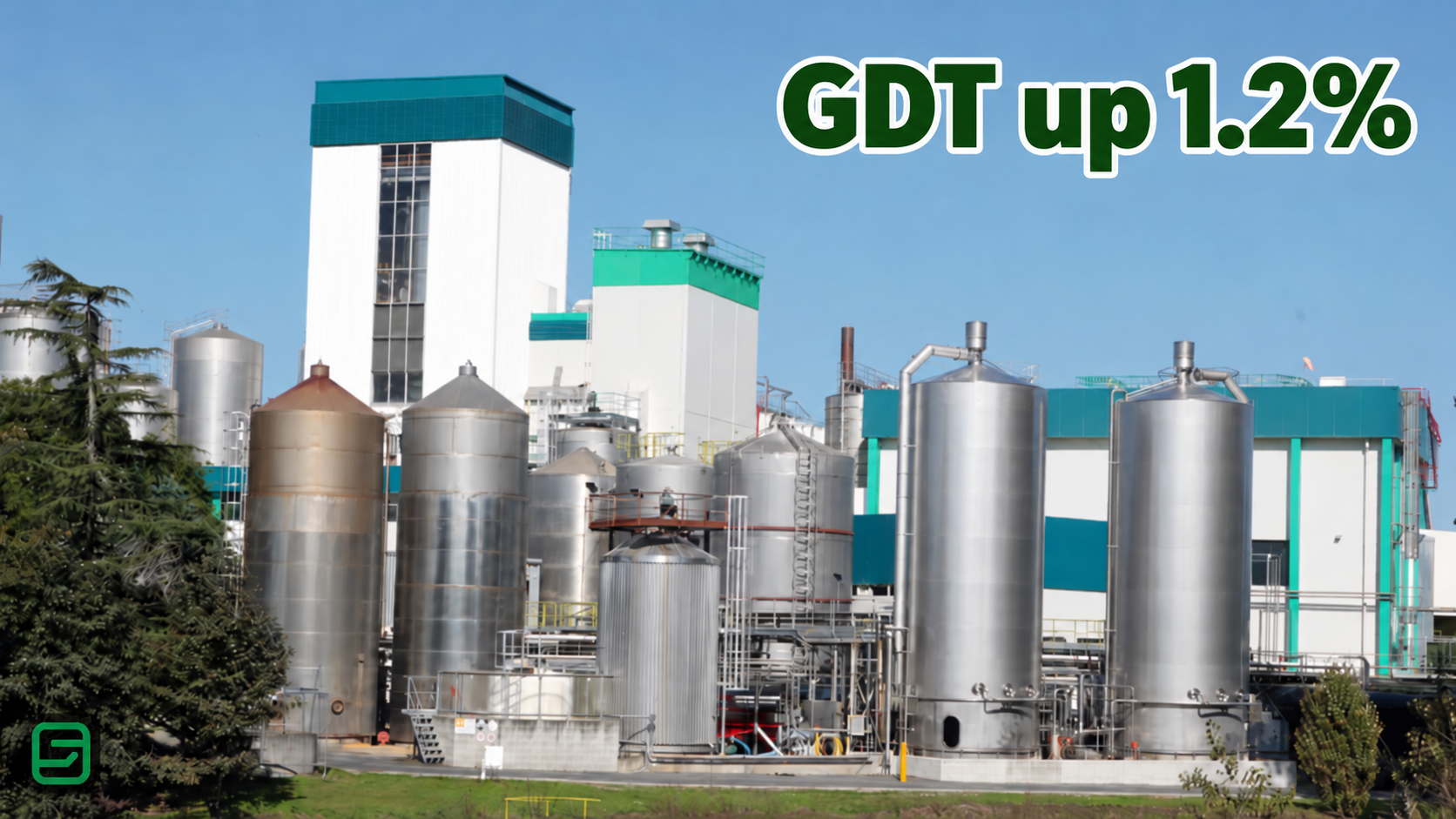
Milk powder prices have given New Zealand dairy farmers another positive signal, with the latest Global Dairy Trade auction lifting 1.2%. The gain is useful support for the season’s milk-price outlook, although the detail shows a market moving at different speeds. [1]
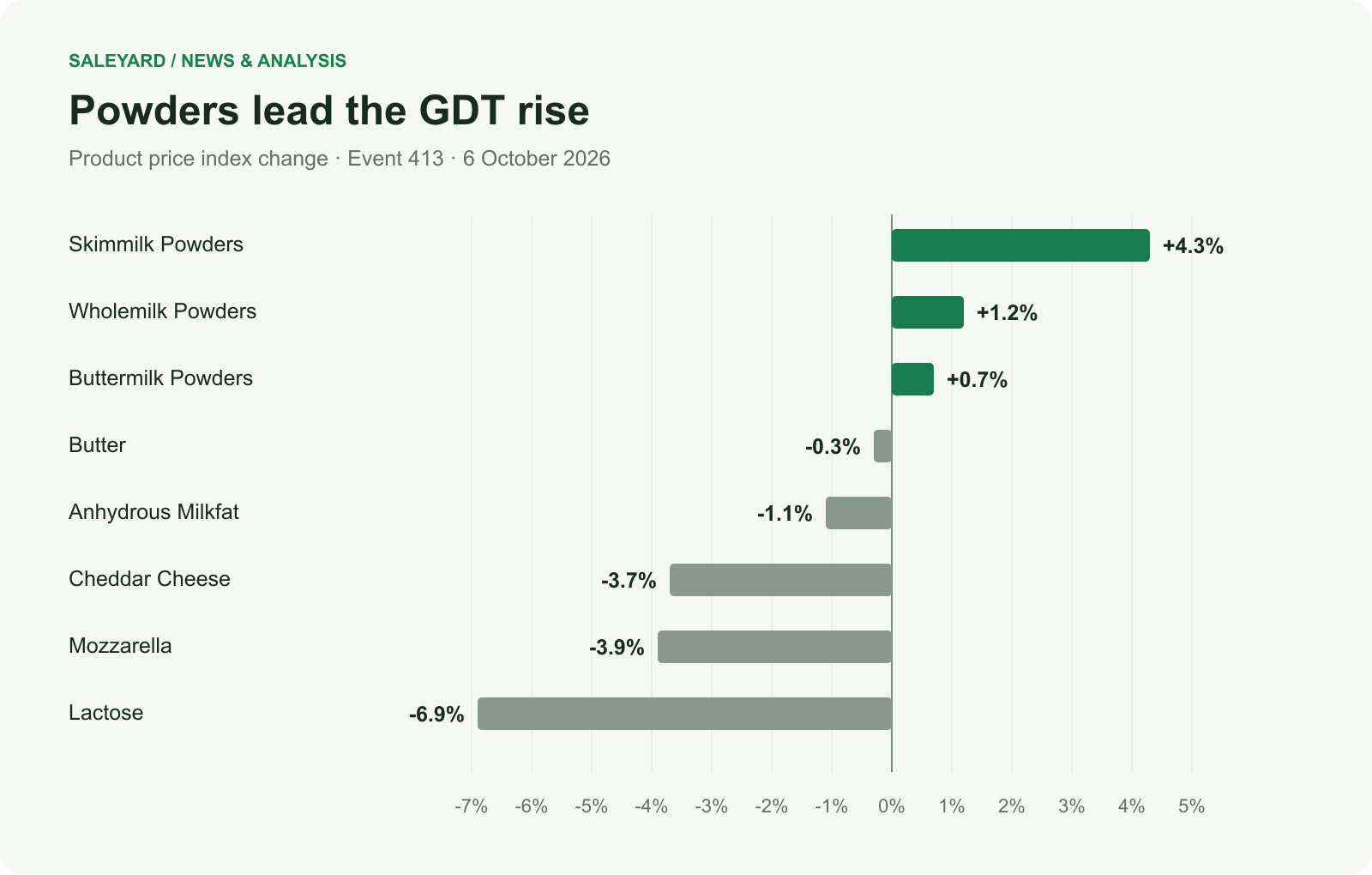
Skim milk powder rose 4.3% and whole milk powder gained 1.2% at Event 413, held on 6 October in UTC time and overnight into 7 October in New Zealand. Butter, anhydrous milk fat and cheese moved lower. For farmers, the powder result matters more than the headline alone: those products sit at the centre of Fonterra’s farmgate milk-price calculation. [1] [3]
The immediate implication is greater support for the assumptions behind the current forecast. A further payout increase would require a separate decision by the co-operative, informed by the broader season’s sales and costs.
Powders provide the lift
The auction sold 41,692 tonnes at an average price of US$3,928 a tonne. Whole milk powder averaged US$3,605/t and skim milk powder US$3,847/t. These are export ingredient prices in US dollars, rather than a price for the milk leaving a New Zealand farm. [1]
The 1.2% movement is the GDT price index change. It compares price movements across the products sold; the average dollar price can also change because the mix of products changes. The index is the better measure when judging whether dairy prices rose between auctions. [4]
View chart data
| product | changePercent | averageUsdPerTonne |
|---|---|---|
| Anhydrous Milkfat | -1.1 | 5683 |
| Butter | -0.3 | 4740 |
| Buttermilk Powders | 0.7 | 4123 |
| Cheddar Cheese | -3.7 | 3925 |
| Lactose | -6.9 | 1677 |
| Mozzarella | -3.9 | 3833 |
| Skimmilk Powders | 4.3 | 3847 |
| Wholemilk Powders | 1.2 | 3605 |
The stronger powder result came alongside a 0.3% fall in butter, a 1.1% decline in anhydrous milk fat and a 3.7% fall in cheddar. It is therefore too early to describe the result as a recovery across all dairy products. Buyers paid more for some ingredients and less for others. [1]
Nor does the public headline result establish which country drove the rise, or whether buyers were rebuilding depleted inventories. Price and volume tell us where the auction cleared; they do not, on their own, explain the motives behind every bid.
Why the powder result matters here
Fonterra’s milk-price model uses whole and skim milk powders and their by-products: butter, anhydrous milk fat and buttermilk powder. It assesses commodity revenue against processing and selling costs. Cheese is outside that reference basket, even though it matters to the wider dairy business. [3]
That makes a powder-led gain relevant to the farmgate outlook. However, the falls in milk fats are a reminder that the returns from the reference basket do not all move together. The 1.2% all-product index cannot simply be applied to Fonterra’s milk-price forecast. [3] [1]
Currency also matters. Reference products are sold in US dollars, on and off GDT, and converted at exchange rates achieved by Fonterra. Currency outcomes can reinforce or partly offset a favourable auction. On farm, the relevant return is in New Zealand dollars per kilogram of milksolids. [3]
Support for $9.50, rather than a new payout
Fonterra’s latest published 2026/27 forecast midpoint remains $9.50/kgMS, within a range of $8.50–$10.50. The September update raised the midpoint by 25 cents. Today’s auction result is fresh evidence for that outlook; it is not a new milk-price announcement. [2] [6]
“Geopolitical volatility remains and, with only two months complete, previous seasons tell us that things can always change” [2]
The next question is whether the stronger powder prices persist. Repeated gains across subsequent auctions would provide firmer evidence than one result. The timing and terms of sales across the season also matter, so the return from an individual auction is only one part of the eventual milk-price outcome.
For a farm already budgeting at $9.50/kgMS, the auction alone does not create extra income to spend. For a farm using a lower planning price, it offers some encouragement, but any budget change should still be tied to the processor’s forecast and the farm’s expected production.
The value on farm still depends on the margin
A stronger price outlook can improve the case for producing extra milk, but it does not make every extra kilogram profitable. DairyNZ’s supplementary-feed research finds that the milksolids response to feed is central to profit, and that the response generally falls as more supplement is fed. [5]
That distinction is particularly useful when assessing a spring feed purchase. Feed that fills a genuine pasture deficit can have a different return from feed that replaces pasture cows would otherwise have eaten. The relevant calculation is the extra milk revenue against the full additional cost, including wastage and the cost of handling and feeding the supplement. [5]
Consider an illustrative sensitivity check: a 10-cent change in the milk price is worth $10,000 in gross revenue on 100,000kgMS of supply, with production held constant. That is arithmetic, not a forecast from this auction. A farmer cannot assume the GDT increase will deliver that change, or that gross revenue will become an equivalent increase in surplus.
The practical response to this result is to revisit the assumptions, rather than rush to add cost. Keep the milk-price scenario, production estimate and cash-payment timing separate. Then test any additional spending against the milk response needed to cover it.
What the next auction needs to show
Whole milk powder will remain a useful indicator for New Zealand, alongside skim milk powder and the milk-fat products. Another powder gain would strengthen the case that this improvement is holding. A reversal, or further weakness in the by-products, would make the outlook less straightforward.
For now, farmers have a better auction result and a powder market that has moved in their favour. The benefit is a little more confidence behind the season’s forecast. Turning that confidence into a stronger farm surplus still depends on the price ultimately paid, the milk delivered and the cost of producing it.