
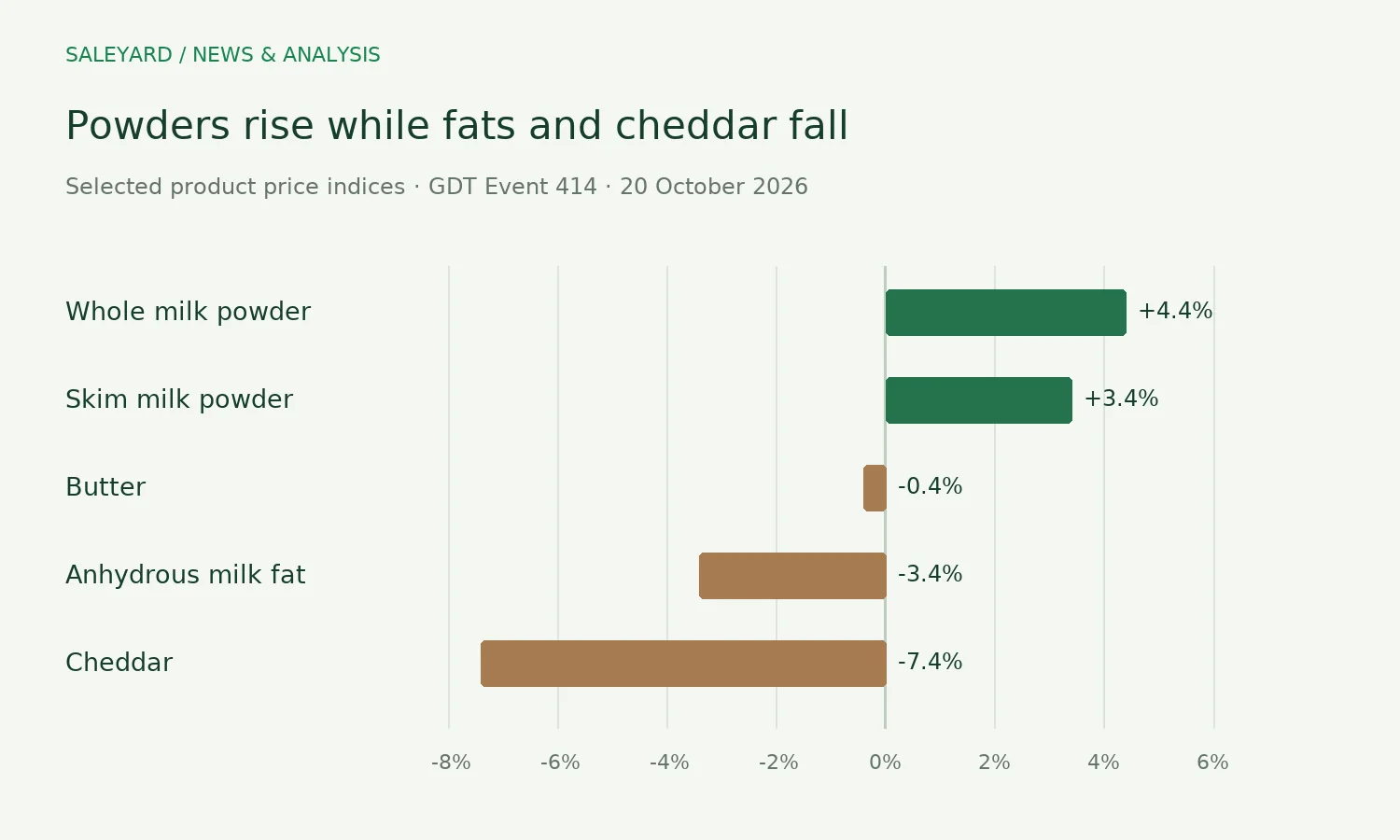
Global dairy prices have risen again, giving New Zealand’s milk exporters a stronger powder-price signal while leaving other parts of the market under pressure. The GDT Price Index increased 2.5% at the 20 October auction, with whole milk powder up 4.4% and skim milk powder up 3.4%. [1]
The result followed the 1.2% index rise at the previous event. It strengthens the case that powder prices have improved across the two October auctions, but does not establish that every dairy commodity is recovering. Cheddar fell 7.4% at the latest sale, while butter slipped 0.4% and anhydrous milk fat fell 3.4%. [1] [2]
A better powder price, an uneven dairy market
Whole milk powder averaged US$3,760 a tonne and skim milk powder US$3,975. Across all products, the average winning price was US$4,021 a tonne, with 42,088 tonnes sold. These are auction ingredient prices in US dollars, rather than payments for raw milk supplied by a New Zealand farmer. [1]
View chart data
| Selected product | Price-index change (%) | Average winning price (US$/tonne) |
|---|---|---|
| Whole milk powder | 4.4 | 3760 |
| Skim milk powder | 3.4 | 3975 |
| Butter | -0.4 | 4721 |
| Anhydrous milk fat | -3.4 | 5488 |
| Cheddar | -7.4 | 3645 |
The split matters because a processor sells a mix of products. A stronger return for one ingredient can be partly offset by weakness elsewhere. It would be misleading to apply either the whole milk powder increase or the cheddar decline to the entire value of a tanker of milk.
Nor does the result identify why buyers paid more. The public figures establish the prices achieved, but they do not by themselves prove a surge in demand from a particular country or that a weather forecast caused the increase. Those explanations require evidence beyond the auction headline.
Why the powder result matters for the milk price
Fonterra’s milk-price methodology uses a reference business making whole and skim milk powders, butter, anhydrous milk fat and buttermilk powder. It assumes sales in US dollars, on and off GDT, converted at exchange rates achieved by Fonterra, with manufacturing and other relevant costs deducted. [4]
Cheddar is not one of those five reference products. Its sharp fall is evidence of an uneven ingredient market, but it should not be presented as a direct input into Fonterra’s reference milk-price basket. Conversely, the declines in butter and anhydrous milk fat are relevant to that basket alongside the powder gains. [4] [1]
A single auction also cannot settle a season’s return. The eventual farm-gate outcome depends on the prices achieved across sales, currency conversion and costs. This result is supportive information for powder returns; it is not an announced increase in a processor’s milk-price forecast.
The index and the average price answer different questions
GDT’s percentage movement is a price-index change. It is not simply the percentage difference between this auction’s average winning price and the previous average. The index accounts for price changes across product specifications, while the average can also move because the mix of products sold changes. [3]
That distinction is useful when comparing results over time. A higher average can reflect a larger share of expensive products, even if their individual prices have not risen. The 2.5% index increase is the appropriate headline measure of this event’s overall price movement. [3]
A stronger selling signal still needs a farm margin
For dairy businesses reviewing spring spending, better export prices and profitable extra production remain separate questions. Additional revenue has to cover the feed, labour and other costs needed to earn it. The auction does not reveal the milk response to an extra tonne of supplement on an individual farm.
The useful next signals are whether powder gains persist at subsequent auctions, how the other reference products perform and what processors say in their own forecast updates. The latest result improves the powder picture. It leaves enough variation elsewhere to make a blanket claim of a dairy-price recovery premature.