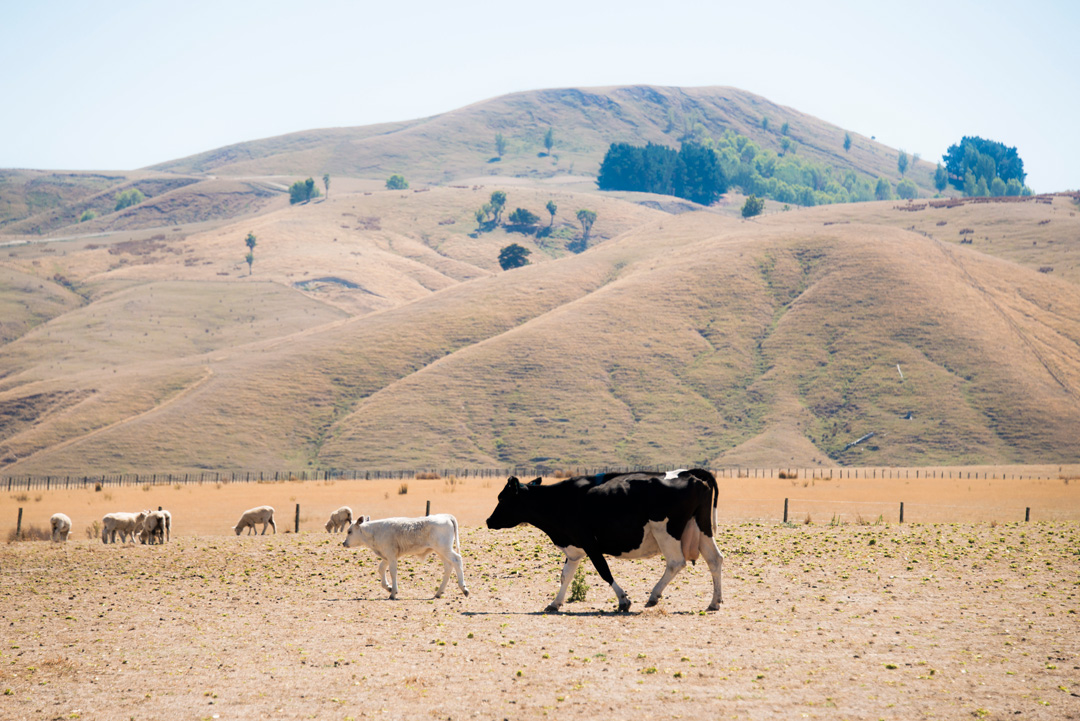

The most expensive part of a dry summer can be the decision made while the farm is still green: another line of cattle bought, feed reserves committed elsewhere, or an assumption that autumn growth will arrive on time. September’s El Niño outlook gives those decisions greater weight. It calls for a farm budget that can cope with a difficult season before the weather forces a change.
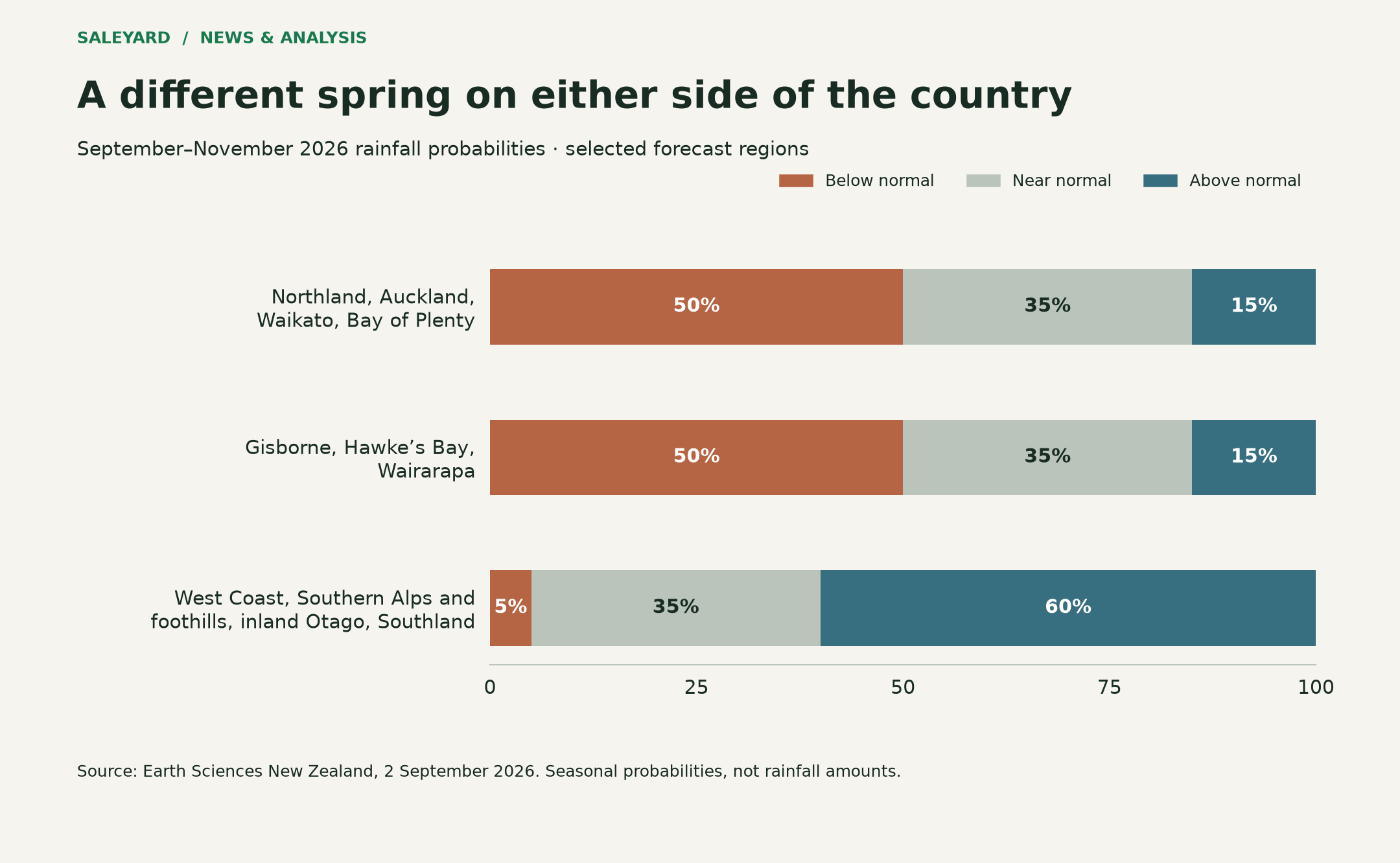
Earth Sciences New Zealand’s 2 September outlook favours below-normal spring rainfall in the north and east of the North Island. The west of the South Island has a distinctly wetter outlook. Stronger westerly winds and variable temperatures add to the challenge. This is a regional pattern of risk, not a forecast that every New Zealand farm will face drought. [1]
View chart data
| Forecast region | Below normal % | Near normal % | Above normal % |
|---|---|---|---|
| Northland, Auckland, Waikato, Bay of Plenty | 50 | 35 | 15 |
| Gisborne, Hawke’s Bay, Wairarapa | 50 | 35 | 15 |
| West Coast, Southern Alps and foothills, inland Otago, Southland | 5 | 35 | 60 |
The probabilities describe the September–November period as a whole. A 50% chance of below-normal rainfall does not mean half the usual rain will fall. Nor does a wet week settle the outlook for the months ahead. The timing of rain, the soil’s starting moisture and the pasture already available all matter to an individual farm. [1]
Earth Sciences NZ chief scientist for weather and seasonal forecasting Chris Brandolino made the uncertainty clear when the event was declared in July: “no El Niño is average”. His point was that each event has its own combination of climate conditions. Farmers can use the regional signal to prepare without treating a historical drought as a timetable for this season. [2]
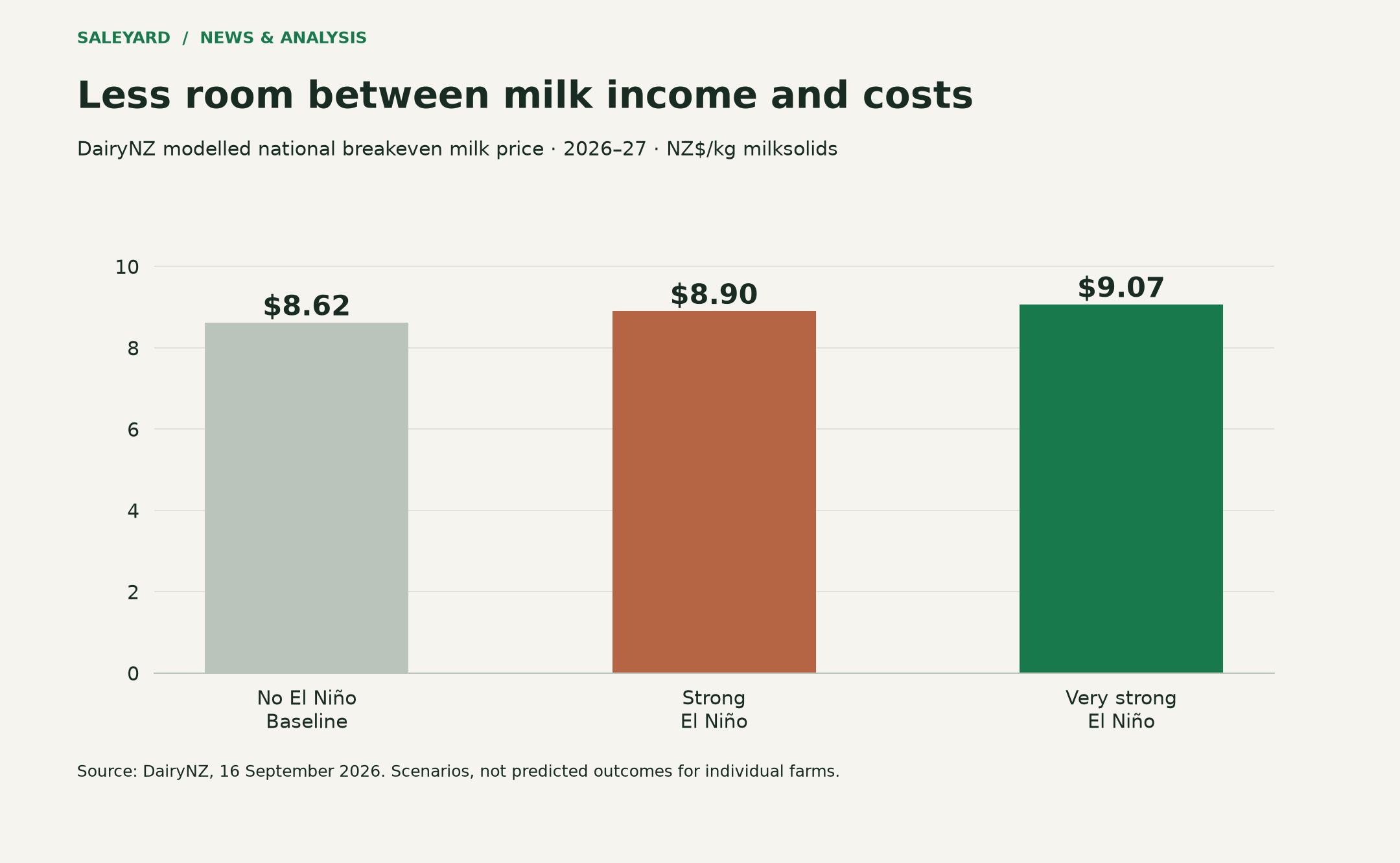
DairyNZ’s modelling released on 16 September shows how a weather shock can work through the accounts. Its national breakeven milk price for 2026–27 rises from $8.62/kgMS without El Niño to $8.90 under a strong event and $9.07 under a very strong event. National milk production is modelled 2.1% and 3.3% below the baseline respectively. [3]
View chart data
| Scenario | NZD/kgMS |
|---|---|
| No El Niño | 8.62 |
| Strong El Niño | 8.9 |
| Very strong El Niño | 9.07 |
Those production changes can look manageable at first glance. The economic difficulty is that losing output need not remove much of the farm’s cost. Interest, staff and infrastructure still have to be paid for, while buying feed to protect production can add another bill. The cost carried by each kilogram sold then increases.
The scenarios include management responses, rather than assuming farmers do nothing. Feed expenses rise from $1.56 to $2.02/kgMS in the very strong case. That measures cost per unit of milk, not feed’s purchase price. National averages also conceal potentially harder outcomes on individual farms. [3]
For a cattle finisher, the corresponding risk is time. An animal that takes longer to reach sale weight occupies pasture and ties up money for longer. If it must leave early, fewer kilograms may be sold. If it stays, the feed and finance required to finish it can increase. A favourable schedule cannot by itself resolve that trade-off.
An illustrative calculation shows why weight matters. A 300kg carcass at $9/kg returns $2700. A lighter 280kg carcass at the higher price of $9.30/kg returns $2604. Despite a 30-cent improvement in price, gross revenue is $96 lower. These are arithmetic examples, not schedule quotations; they exclude differences in grading and selling costs.
That is the exposure to examine when buying spring cattle. The budget needs a plausible sale date under slower growth, the feed needed to reach it, and an alternative if the farm cannot carry the animals that long. A purchase that works only with uninterrupted summer growth leaves little room to respond.
B+LNZ’s established dry-management guidance links the feed budget to the financial budget. Its options include earlier sales, grazing elsewhere, supplementary feed and early weaning where appropriate. The starting task is an inventory of feed on hand, including conserved feed, followed by regular revision as conditions change. Feed quality also matters: a tonne in the stack is not a guarantee of the animal performance assumed in the budget. [4]
Purchased feed brings its own calculation. DairyNZ’s supplement guidance asks farmers to consider energy content, dry matter, storage, wastage and feeding arrangements as well as price. A cheap delivered tonne can become expensive feed if much of it is water, lost in storage or left uneaten. [5]
For example, feed costing $400 a delivered tonne at 90% dry matter contains 900kg of dry matter. If 10% of that dry matter is wasted, 810kg is available to be eaten, making the purchase cost about 49 cents per usable kilogram before feeding-out costs. With 20% wastage, that rises to about 56 cents. These illustrative assumptions show why price per tonne alone is an incomplete comparison.
The purchase also commits cash before the return is known. Storage space, delivery dates and the ability to distribute feed efficiently can be as important as securing supply. The relevant comparison is between feasible options for that farm: buying feed, reducing demand, using outside grazing, or changing the timing of sales. The cheapest invoice is not necessarily the lowest-cost response.
On dairy farms, DairyNZ recommends setting action points while options remain open: growth below budget, falling pasture cover or residuals below target. It also stresses checking stock-water capacity and irrigation reliability. Where conditions turn wet, protecting soils and maintaining access to feed become priorities. The same seasonal outlook therefore calls for different preparations on different properties. [6]
A useful action point pairs a measurement with a decision and a review date. For example, a farm team can agree what combination of pasture cover and forward feed deficit would prompt a review of discretionary stock. The threshold should come from the farm’s own feed demand and system; there is no single national number that makes the decision sound.
Timing matters beyond the paddock. DairyNZ warns that widespread feed shortages can constrain processing capacity. A plan to remove stock therefore needs a practical route off farm. Feed and livestock decisions should account for transport and delivery arrangements before a date is entered in the budget. [6]
The final test is what remains after summer. Using reserves can protect production now, but it may leave a larger requirement for autumn or winter. Selling animals reduces demand, but changes future income and potentially replacement costs. These consequences belong in the same calculation as the immediate feed bill.
A farm that knows its feed position and has priced its alternatives can change course as the evidence develops. That is the economic value of preparing in spring: decisions can be made while there is still a choice of timing, buyers and feed sources, rather than after pasture and cash have both become scarce.