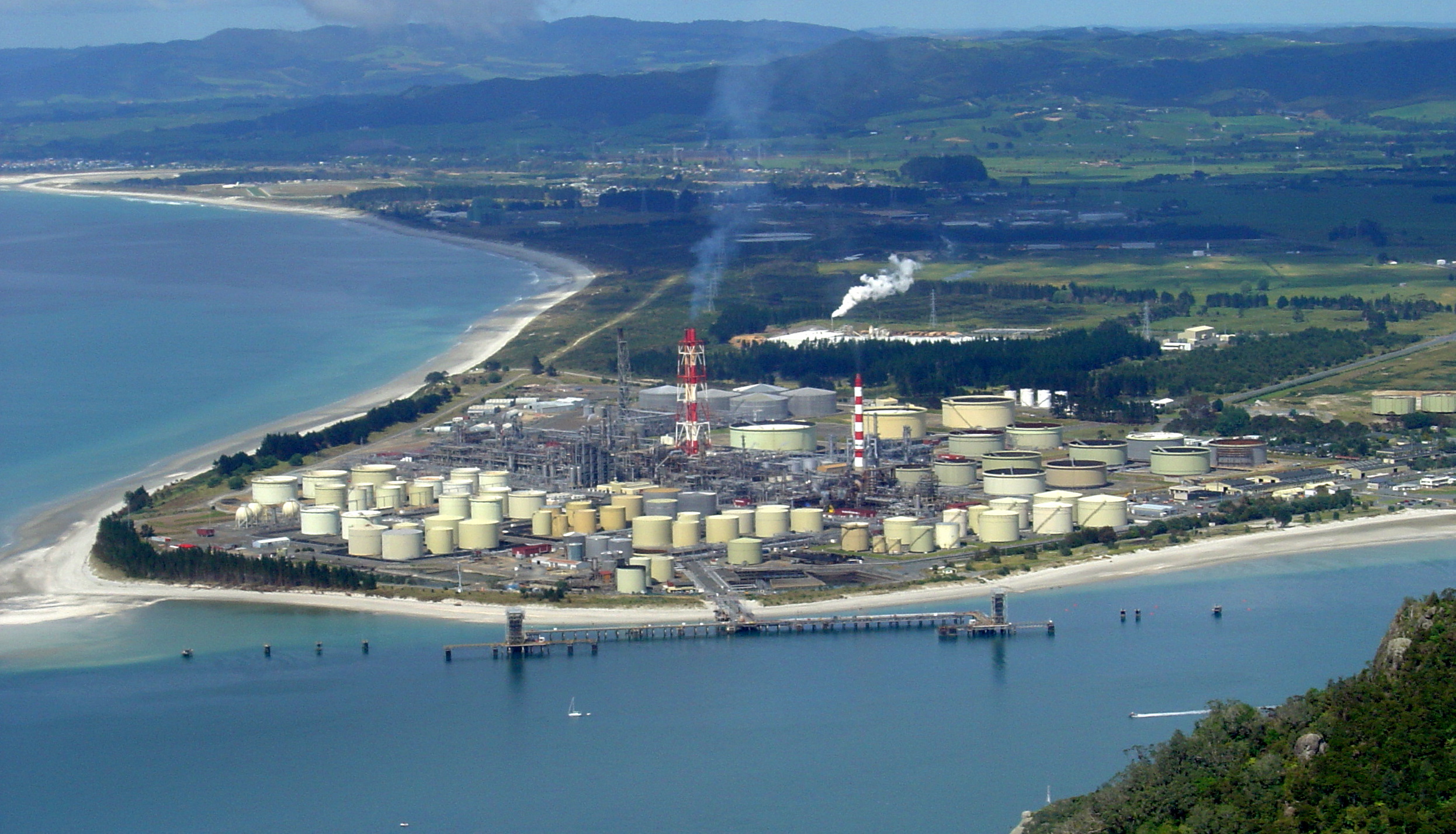

New Zealand’s strategic diesel reserve will remain available under an extended agreement until 1 August 2027, keeping a national supply buffer in place for farms and the freight businesses they rely on. The Government announced the extension on 14 October. [1]
The 550,000-barrel reserve is held at Marsden Point under an agreement with Z Energy. Its purpose is resilience against a supply disruption. For a farm budget, however, continuity and affordability are different risks: fuel can remain available while the cost of using it rises. [1]
Associate Energy Minister Shane Jones said fuel supplies remained consistent. His description of diesel’s role included “farms growing our food to trucks moving goods around our country”. The extension is a precaution against disruption, rather than an announcement that ordinary supplies have stopped. [1]
A national reserve is not a farm delivery booking
Z Energy will continue to own and manage the diesel, while the Crown controls its release into the domestic market. Ministers describe the storage as allowing around 90 million litres, equivalent to roughly nine days of typical national consumption. That is a national comparison, not nine days guaranteed to each farm. [1]
A bulk reserve and a delivery to a farm tank solve different parts of the problem. Releasing stock still leaves distribution between storage, fuel suppliers and customers. A national buffer therefore does not remove the need to understand a farm’s delivery arrangements or a contractor’s ability to complete time-sensitive work.
The consequence of a delay can extend beyond the litres involved. If machinery, a contractor or a freight movement is unavailable when required, a farm may lose the opportunity to complete a job at the right time. That is a potential operational cost; the announcement does not quantify losses avoided on individual farms.
Do not add different stock measures together
The strategic arrangement is also distinct from fuel importers’ minimum stockholding obligations. MBIE describes the current diesel obligation as 21 days’ cover, calculated using a defined historical-demand period. Its published rules provide for importers above 10% market share to move to 28 days from 1 July 2028. [2]
That future obligation is not the change announced yesterday. Nor does adding “nine days” to “21 days” establish how long New Zealand could operate in a particular emergency. A valid total would need consistent measurement dates, demand assumptions and stock coverage; those conditions cannot be inferred from two headline figures.
For farmers, the useful distinction is between a specific reserve controlled for release by the Crown, an importer’s regulatory obligation and the commercial arrangements through which fuel reaches the property. Each can support resilience, but they are not interchangeable promises.
The price exposure stays in the budget
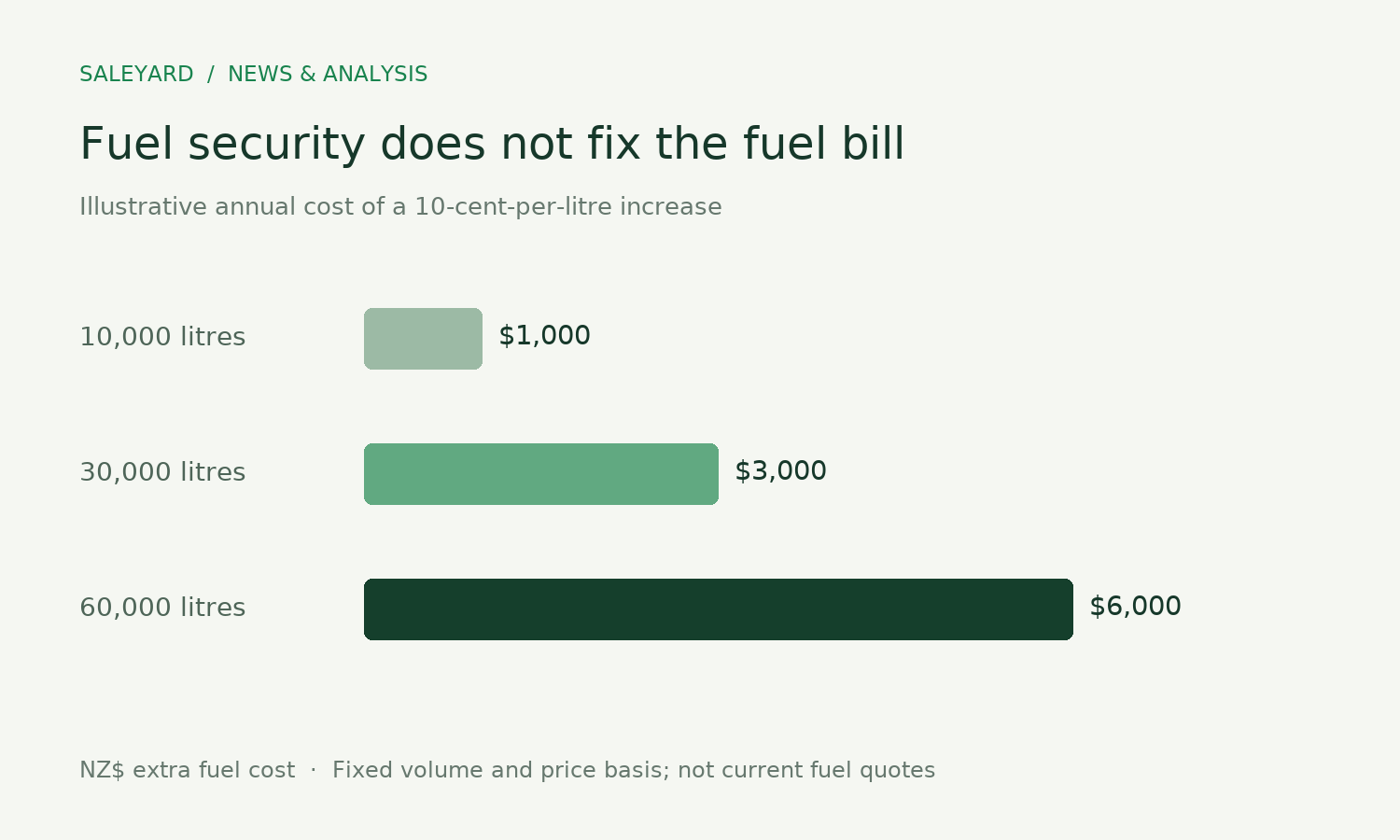
Nothing in the extension announcement sets a farm diesel price or promises a discount. Even if supply remains dependable, the financial effect of a price change depends on the litres bought. At fixed annual use of 30,000 litres, a 10-cent-per-litre increase adds $3,000. At 60,000 litres, it adds $6,000.
View chart data
| Assumed annual use (litres) | Assumed price increase (NZ$/litre) | Extra annual cost (NZ$) |
|---|---|---|
| 10000 | 0.1 | 1000 |
| 30000 | 0.1 | 3000 |
| 60000 | 0.1 | 6000 |
These examples hold volume and the price basis constant. They are not current diesel quotes and do not estimate a particular farm’s tax treatment or recoverable GST. Their purpose is to isolate the cost exposure that a supply-security announcement does not remove.
The same distinction applies when comparing contractor offers. An apparent saving from a lower rate can disappear if the work requires more hours, extra travel or a second visit. Conversely, paying for reliable completion can have value when the timing of the job affects the rest of the farm system. Those comparisons need the actual terms and the cost of a missed window.
More time to respond, rather than certainty about every outcome
A farm can treat supply continuity and price sensitivity as separate lines in its planning. The first concerns whether essential work can proceed. The second concerns what that work costs. The reserve extension strengthens the national arrangements behind the first, while leaving the second to be managed through the farm’s own purchasing and operating decisions.
That is the important limit of the announcement. Keeping a reserve available into 2027 supports the ability to respond if supply is threatened. It does not turn a national stockholding agreement into a guaranteed delivery date or a cheaper tank of diesel.