
Dairy farmers have a new opportunity to tell officials how competition works at the farm gate, as the Government reviews the rules governing Fonterra. MPI added a farmer-experience survey on 14 October, seeking accounts of the market from the people selling milk into it. [1]
The immediate development is the survey, rather than a decision to change dairy regulation. Its significance lies in the evidence it could bring to a difficult question: does a farmer have a workable choice of buyer, or simply a list of processors operating somewhere in New Zealand?
MPI says the survey should take about five minutes. It sits alongside the wider Dairy Industry Restructuring Act review, whose issues-paper consultation closes at 5pm on 23 November. The ministry is examining whether Fonterra’s competition provisions should be kept, changed or repealed. [1]
A second buyer has to be a real option
Competition is useful to a farm business when an alternative can be acted on. A processor’s national presence does not, by itself, establish that it will collect from a particular property, accept its milk profile or offer terms that make a move worthwhile. These are practical questions for comparing offers, rather than findings about any named processor.
The distinction also changes what counts as useful evidence. A dated account of trying to switch, the terms offered and the reason a move proceeded or failed can reveal more than a general statement that the market is competitive or uncompetitive. It separates the existence of a rival from the ability to use one.
MPI identifies farmer switching and milk-price transparency among the matters in the review. Its consultation material is an invitation for evidence, not a conclusion that the present system has failed. [1]
Small price differences can carry a large cheque
The financial scale is easy to underestimate when offers are expressed in cents per kilogram of milksolids. At unchanged production of 250,000kgMS, a 10-cent difference is $25,000 in gross seasonal milk revenue. At 500,000kgMS it is $50,000. Those are arithmetic examples, not forecasts of a benefit from the review.
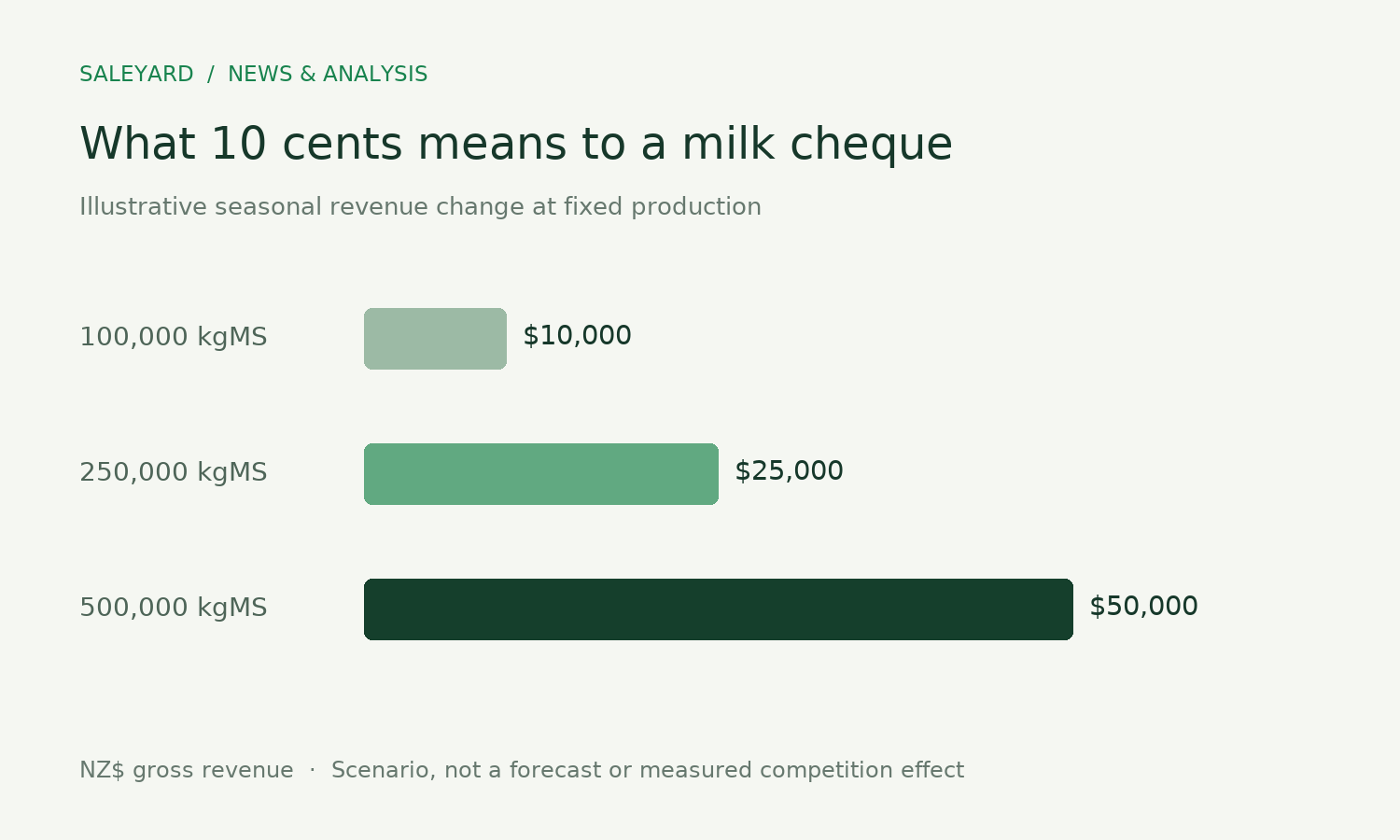
View chart data
| Assumed production (kgMS) | Assumed change (NZ$/kgMS) | Gross revenue change (NZ$) |
|---|---|---|
| 100000 | 0.1 | 10000 |
| 250000 | 0.1 | 25000 |
| 500000 | 0.1 | 50000 |
A bigger headline price is only the start of a comparison. Any costs attached to earning it must also be counted, alongside when the cash arrives and what obligations come with the offer. An illustrative $25,000 increase in milk revenue would leave $10,000 before tax if it required $15,000 of additional annual spending. Neither figure describes an actual supplier contract.
That is why a review of competition should be judged against the whole farm transaction. The useful outcome is not merely a different number in a price announcement. It is an arrangement that leaves the business better off once the conditions of supplying are taken into account.
There is also a scale argument on the other side of the debate. MPI says operational efficiency and scale can support New Zealand’s dairy exporters, while domestic competition can support choice, investment and innovation. The policy task is to weigh both, rather than assume that either a larger co-operative or more processors automatically produces a better farm outcome. [1]
Milk-price monitoring is a different job
There is already a separate annual process examining Fonterra’s milk-price methodology. The Commerce Commission assesses whether the manual supports efficient operation and whether its revenue, cost and other assumptions are practically feasible for an efficient processor. [2]
The Commission says its final report on the 2026/27 manual is due by 15 December. That annual methodology review and MPI’s wider assessment of competition address different questions. A methodology can be examined in detail without resolving whether a particular farmer can realistically change buyers. [2]
For readers following both processes, the distinction matters. Evidence about a farm’s available alternatives belongs in the competition discussion. Evidence about how the base milk price is calculated belongs in the monitoring discussion. Treating one as a substitute for the other risks missing the issue that affects the business.
The survey starts a process, rather than changing this season’s budget
MPI’s stated next steps include a draft report for consultation in February 2027, followed by a final report to Parliament by 1 June. The issues paper makes no final recommendations. Farmers should therefore distinguish the chance to influence the evidence now from any later decision about the rules. [1]
For now, the practical value is in putting specific experiences on the record: what alternative was available, what a farmer needed to do to use it, and what the full financial comparison showed. Those details are what turn an abstract debate about competition into a test of whether farmers have meaningful choice.