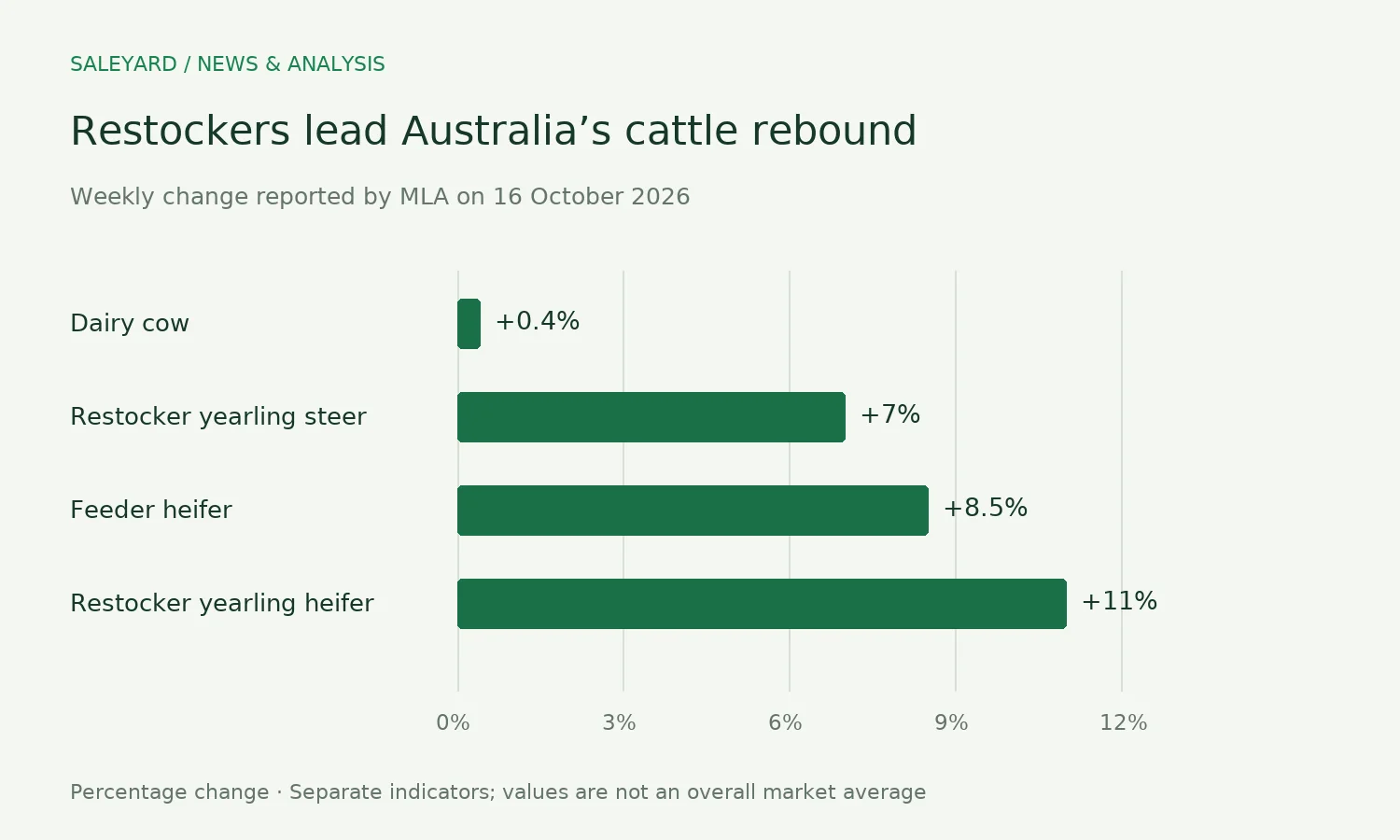
Australian restocker yearling heifer prices rose 11% over the week, leading a cattle-market rebound as rainfall forecasts encouraged some producers to hold stock back. Meat & Livestock Australia’s 16 October market wrap recorded gains across every cattle indicator, alongside a 7% fall in national yardings to 54,403 head. [1]
For New Zealand finishers, the useful signal is how quickly the price of replacement cattle can respond to expectations about feed. A stronger market can improve the value of stock already owned while making the next purchase harder to justify. Australia’s latest figures illustrate that tension; they do not establish a corresponding movement in NZ prices.
The sharpest rise followed a difficult September
The heifer lift comes after substantial recent volatility. In a separate analysis published on 9 October, MLA reported that its restocker yearling heifer indicator had fallen from 477 to 384 Australian cents/kg liveweight between 8 and 28 September, a decline of about 20%. The equivalent steer indicator fell 10% over that period. [2]
MLA senior market information analyst Emiliano Diaz identified the exposure of lighter heifers needing a longer carrying period to seasonal risk. That earlier analysis helps explain why a sudden weekly rise should be read alongside the preceding correction, rather than treated as evidence that buying conditions have become settled. [2]
The two reports describe different periods. Applying the latest 11% rise directly to September’s low would not reconstruct the indicator: intervening changes also matter. Nor does a percentage rebound automatically restore the dollars lost during an earlier decline.
View chart data
| Australian indicator | Weekly change (%) |
|---|---|
| Dairy cow | 0.4 |
| Restocker yearling steer | 7 |
| Feeder heifer | 8.5 |
| Restocker yearling heifer | 11 |
Rain expectations are changing what reaches the yards
The latest wrap describes scattered rain in several dry Australian regions, with more still needed for meaningful relief. Its account of producers retaining cattle shows how a forecast can influence sale decisions before pasture conditions have fully recovered. [1]
Restocker yearling steers rose 7% to 548 Australian cents/kg liveweight. Feeder heifers gained 8.5% to 467 cents/kg liveweight. Those are different classes, with different animals and buying purposes behind their indicators; comparing the headline prices does not isolate a breed, sex or finishing margin. [1]
The concentration of sales also matters. Roma and Wagga Wagga supplied 65% of the restocker steer indicator’s offering, and MLA reported mixed quality. It is a timely Australian market measure, rather than a like-for-like price for every property or line of cattle. [1]
What an 11% rise can do to a buying budget
Consider an illustrative NZ purchase budget, separate from the Australian prices. At NZ$4/kg liveweight, a 250kg animal costs $1,000. An 11% increase in the purchase rate would add $110 a head, or $11,000 across 100 animals, with weights unchanged. The percentage is used to test a budget; it is not a forecast of a NZ price rise.
If the eventual sale cheque and other costs were unchanged, that additional purchase cost would reduce the trading margin dollar for dollar. Better pasture growth could improve the outcome through faster weight gain or lower bought-feed needs, but those benefits would have to be earned. Paying for them in advance transfers some of the expected seasonal improvement to the seller.
A longer carrying period adds another exposure: the farm must maintain feed and working capital until sale. Comparing animals solely on dollars per kilogram at purchase can miss the cost of getting each class to its intended sale point. A cheaper entry price can still produce a weaker result if more time or feed is required.
A buying signal, rather than an export-price forecast
Australia’s rebound is relevant to NZ cattle businesses as evidence of buyers repricing seasonal opportunity and risk. It does not, on its own, establish a change in Australian beef exports or demand for NZ beef. Those claims would require separate supply and trade evidence.
For a spring purchase, the immediate calculation remains the expected sale value less the stock, feed, finance and other costs of reaching it. This week’s Australian market shows why that calculation can change quickly: optimism about grass can reach the purchase price before it reaches the paddock.